Why interactions need structural explanations
A protein's amino-acid sequence is a starting point for understanding its behaviour, but many biological tasks depend on contact with another molecule. An enzyme binds a substrate; a regulatory protein interacts with DNA; an antibody recognizes a molecular surface. The shape and chemical character of an interface help researchers formulate explanations for these events.
For a long time, predicting the structure of a protein and predicting how it interacts with a different molecular partner were often treated as distinct computational problems. A useful model of an encounter must account for more than two attractive-looking surfaces. The partners have internal flexibility, chemical modifications and surrounding water, and an interaction may occur only under particular conditions. Structure prediction addresses an important part of this complexity.
What AlphaFold 3 added in 2024
The AlphaFold 3 paper, published online on 8 May 2024, described a model for predicting complexes involving proteins, nucleic acids, small molecules and other molecular components. The authors reported improved performance on several interaction benchmarks compared with earlier specialized methods. This broadened the kinds of structural hypotheses that could be generated within one modelling framework. [1]
It is important to keep the claim at that level. A benchmark tests specified predictions against selected reference data. It does not show that every suggested complex forms inside a cell, and it does not directly measure a drug's effectiveness. The practical advance is the ability to propose and compare more detailed molecular arrangements before deciding which experiments to perform.
From molecular identity to three-dimensional coordinates
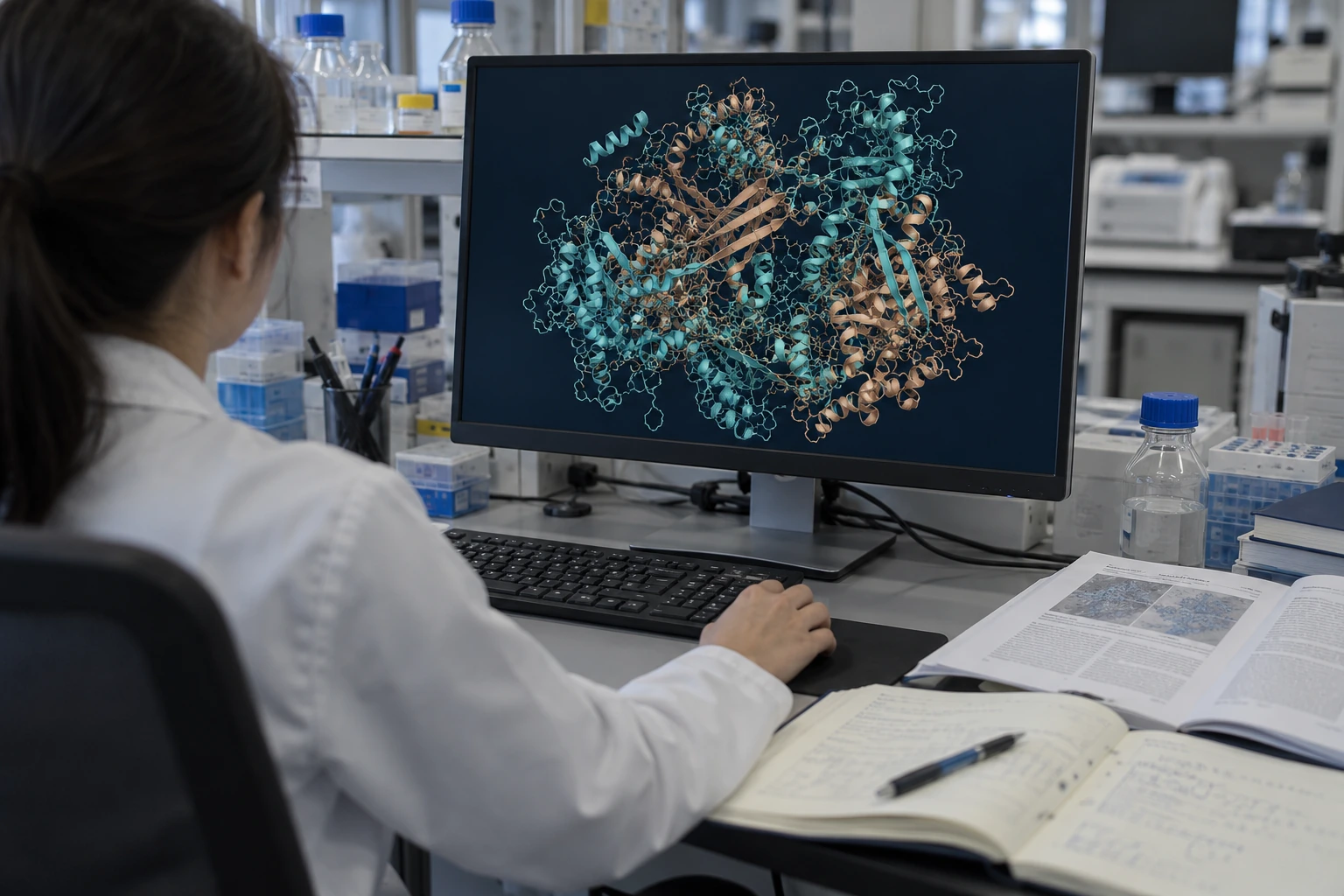
A structural model assigns positions to atoms. From those positions, researchers can inspect distances, orientations, possible contacts and whether a molecule would fit within a binding region. The coordinates make a hypothesis explicit enough to compare with observations. A picture alone can conceal that precision: two colourful renderings may look similar while differing at the few atoms essential to an interaction.
In AlphaFold 3, a diffusion-based component is part of the process that generates structures. That computational choice should not be confused with direct observation of molecular diffusion inside a cell. The model's coordinates are predictions derived from its inputs and learned relationships. Their biological meaning has to be assessed using the relevant region, molecular context and available experimental evidence. [1]
A confidence estimate answers a limited question
A model may be more confident about one folded region than about a flexible segment or an interface between partners. That distinction matters when the scientific question concerns the interface. An apparently convincing overall shape cannot compensate for uncertainty in the specific contact on which the proposed mechanism depends.
Confidence also differs from a direct measurement of binding strength. A tightly specified pose is not a measured dissociation constant, and a plausible binding geometry does not establish how long the partners stay together. Those questions depend on a balance of energetic and entropic contributions in a particular environment. For a reader, the useful habit is to identify exactly what the displayed score describes before treating it as evidence for a broader biological or therapeutic claim.
Experimental structures also need interpretation
A reference structure is not always a complete picture of the biologically relevant complex. In crystallography, the coordinates in an asymmetric unit can differ from the full functional assembly. RCSB PDB-101 explains why an entry may contain one assembly, part of an assembly or multiple assemblies. [2]
This matters when comparing a prediction with a database image. The comparison should involve the intended partners and assembly rather than an arbitrary unit chosen for visualization. Experimental methods also have their own uncertainties and may leave some flexible regions unresolved. A productive comparison asks which structural details are supported by the data and relevant to the question. Prediction and experiment both become more useful when their representations and assumptions are made explicit.
Designing a test of a proposed contact
Imagine a predicted protein complex in which one side chain appears to make an important contact with a partner. A researcher could compare the original protein with a carefully chosen variant and measure binding under matched conditions. If the interaction weakens, that is consistent with the proposed contact contributing to binding, but it is not the only possible explanation.
The variant might instead destabilize the protein or change its abundance. A useful experiment therefore checks those alternatives. A second change predicted to preserve the contact can strengthen the comparison. This is an invented example of hypothesis testing, not a claim about a particular AlphaFold experiment. Its purpose is to show how a structural suggestion becomes scientifically valuable: it helps choose a test whose outcomes distinguish explanations.
A snapshot does not determine a complete energy landscape
Molecules can adopt multiple conformations, and binding changes the freedom of both the partners and their surroundings. A model of one arrangement leaves out the relative populations of other arrangements and the rates of moving between them. Water and ions also participate in the physical setting rather than serving as an irrelevant background.
This is why a visually complementary interface is a starting point for chemical reasoning. It can suggest which interactions to test, but it does not supply all the information required to calculate a binding equilibrium or reaction rate. Connecting a structure to function requires an account of the particular molecular process, including observations that distinguish among its possible states.
Why drug discovery still involves many separate decisions
A small molecule can appear to fit a protein and still be unsuitable as a medicine. It may bind too weakly, interact with other proteins, be unstable in a biological environment or fail to reach the tissue where it is needed. A favourable structural hypothesis addresses one step in a much longer chain of evidence.
Even a genuinely binding compound needs functional measurements. Binding might block a reaction, enhance it or leave it largely unchanged. Cellular experiments then introduce additional questions about transport and off-target effects. The potential value of prediction is that it can focus experimental effort on more informative candidates and mechanisms. Claims about saving research time should be assessed at that decision level, rather than treating a predicted complex as a finished therapeutic result.
How to assess the next molecular AI announcement
Start with the task: what molecular partners were supplied, what was predicted and which result counted as correct? Then examine the comparison. A new model should be assessed against appropriate alternatives on data that meaningfully test its intended use. A performance score on familiar examples may not describe behaviour on a new molecular class.
Finally, connect the output to a consequence that can be measured. Did the model suggest an experiment, discriminate between mechanisms or identify a useful candidate? Was that suggestion tested? These questions let readers appreciate a substantial computational advance without confusing structural plausibility with biological truth. A predicted arrangement is a more precise starting point for investigation; the strongest scientific contribution comes when observations can constrain, refine or overturn it.
Use a predicted structure to design a better test, then let the test constrain the story.
Sources & further reading
Numbered references connect claims to their source. The main text is our original explanation; conceptual examples are identified as imagined.
- Abramson et al. — Accurate structure prediction with AlphaFold 3Research paper · Nature · 8 May 2024
- RCSB PDB-101 — Biological assembliesScientific data resource · interpreting molecular structures
Source review: 30 Oct 2026. Editorial standards.