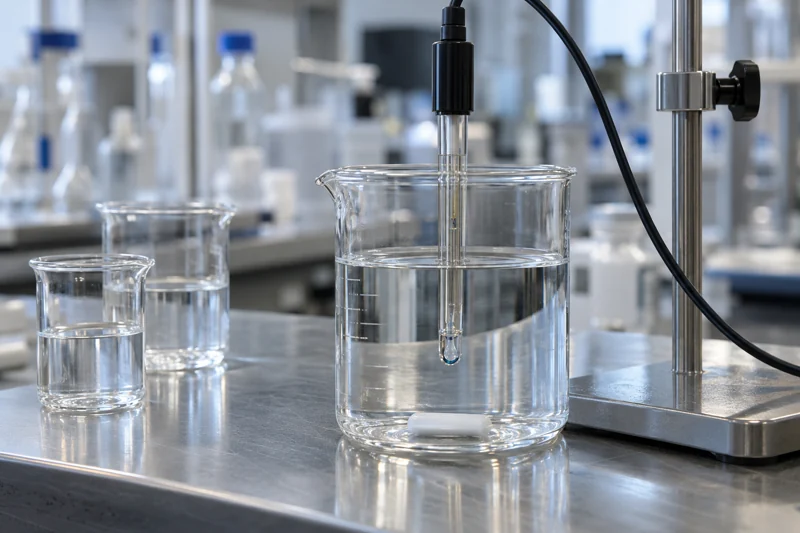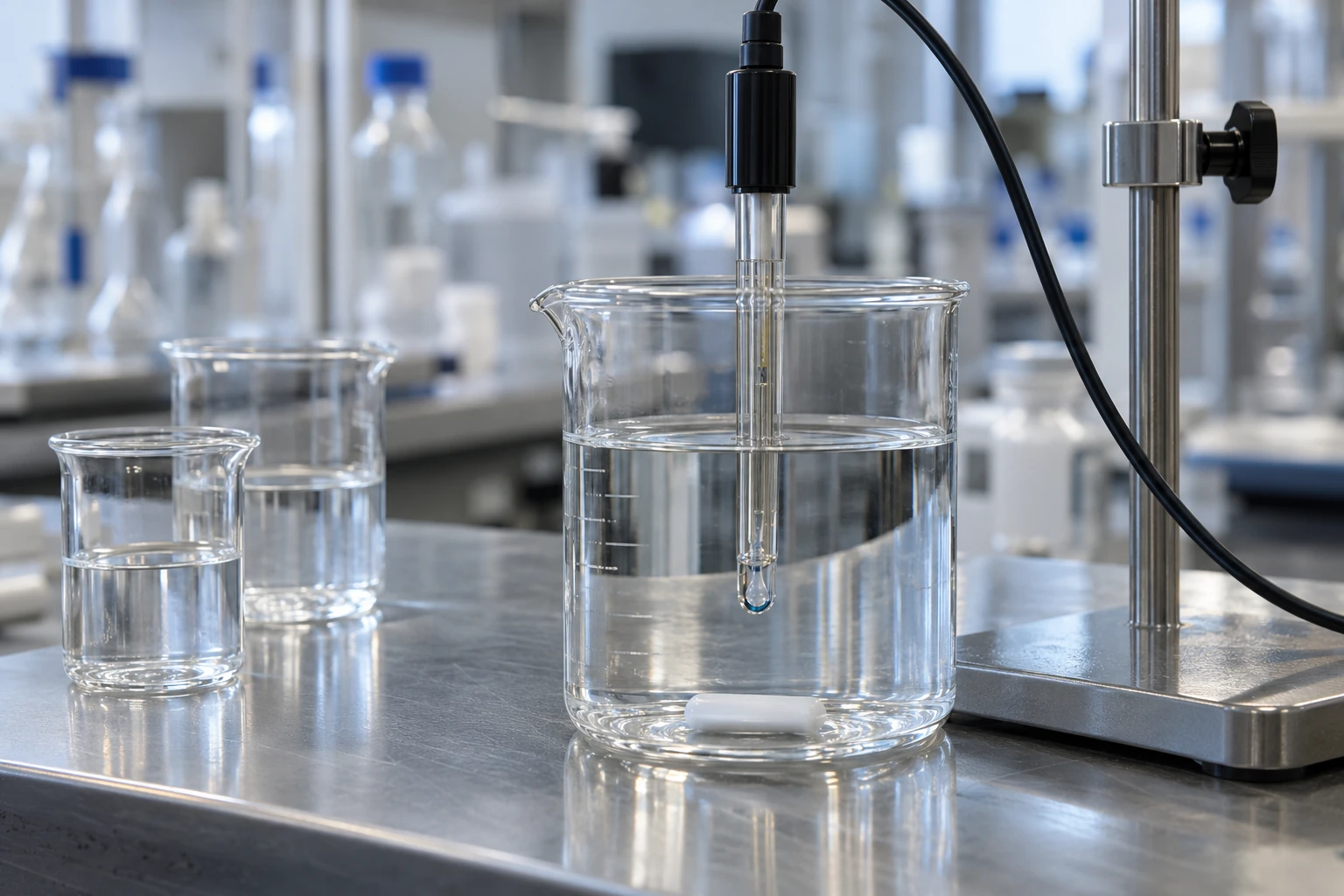
Temperature change is only one part of energy storage
A pan can absorb energy while its temperature rises slowly; a small metal tool can become hot after a much smaller input. The difference is not that one object “contains cold.” It is that a temperature change records only one consequence of energy transfer. Heat capacity connects the energy supplied to the resulting temperature change for a defined sample and set of conditions.
For a substance staying in one phase over a modest temperature range, a useful estimate is Q = m cₚ ΔT at roughly constant pressure. Here Q is transferred heat, m is mass, cₚ is specific heat capacity, and ΔT is the temperature change. Specific heat capacity is energy per unit mass per degree. It is different from total heat capacity: a large bath of ordinary water can require more energy to warm than a small sample of the same substance simply because the bath has more mass. [1]
Water’s value makes the scale tangible
Near room temperature, liquid water’s specific heat capacity is about 4.18 kilojoules per kilogram per kelvin. The IAPWS formulation provides thermodynamic properties, including heat capacity, and its value changes with temperature and pressure; the rounded figure is therefore a practical estimate, not a universal constant. [1]
As a worked example, imagine warming 0.50 kg of water by 8 °C without boiling or freezing it. Using the rounded value gives Q ≈ 0.50 kg × 4.18 kJ kg⁻¹ K⁻¹ × 8 K, or about 16.7 kJ. This is a calculated illustration, not a measurement. A real kettle or pan also warms its container and loses energy to surrounding air, so the electrical input would be higher than the heat gained by the water alone.
Molecular interactions add ways to store energy
Temperature is linked to the distribution of molecular motion, but the energy of a liquid is not only a tally of molecules moving faster. Water molecules are polar and attract one another through hydrogen bonds. In liquid water, this network continually rearranges. Added energy can change both molecular motion and the configuration of those intermolecular attractions, contributing to the measured heat capacity. OpenStax presents hydrogen bonding as a contributor to water’s high heat capacity; this is a useful molecular account, not a claim that each added joule first breaks a fixed set of bonds before any temperature rise occurs. [4]
That distinction matters because liquid water is dynamic rather than a rigid molecular scaffold. Its measured heat capacity reflects the collective response of the liquid under specified conditions. Thermodynamic measurements and molecular descriptions answer related but different questions: one gives the energy–temperature relationship, while the other helps explain why water’s response differs from that of many familiar materials.
A heat reservoir can move energy without erasing it
The ocean is consequential because it combines water’s heat capacity with an enormous mass, broad surface area and circulation. A given energy input can produce a smaller temperature change in a large water mass than in a much smaller mass, while currents redistribute energy between regions and depths. NOAA’s heat-content account describes how ocean observations are converted into stored-energy estimates and how heat can later move into other parts of the climate system through evaporation, melting and exchange with the atmosphere. [2] [3]
This is a buffer against rapid temperature swings, not a shield that prevents warming. If more energy enters the ocean than leaves over a period, its heat content rises even when a local surface thermometer changes relatively little. NOAA’s analysis combines measurements from ships, floats and other instruments because surface temperature alone cannot describe energy stored throughout the water column. [2]
Heat capacity is not heat transfer speed
A large heat capacity does not mean heat moves quickly through a material. Heat capacity describes how much energy changes temperature; thermal conductivity describes how readily energy passes through a material in response to a temperature gradient. A water-filled bottle may take a substantial energy input to warm overall, yet the time needed depends on bottle shape, stirring, contact with the heater and heat loss. Conflating storage with transfer leads to poor predictions about cooking, cooling systems and environmental measurements.
The same separation applies to latent heat. During melting or boiling at the phase transition, energy can change the fraction of material in each phase while temperature remains near the transition value. The simple Q = m cₚ ΔT estimate is not enough across such a transition; an additional phase-change term is needed. It also assumes no chemical reaction and a reasonably uniform sample temperature.
Use the equation as a model, then check the conditions
For a first estimate, identify the material, its mass, initial and final temperatures, and whether pressure or composition is changing. Choose a heat-capacity value near the relevant temperature range. If that value changes appreciably over the interval, integrate or use tabulated enthalpy differences instead of treating cₚ as constant. For a mixed or salty solution, do not assume pure-water values apply exactly.
The practical lesson is that a small temperature change does not necessarily mean little energy was exchanged. It may reflect a large mass, a substantial heat capacity, energy moving elsewhere, or several effects at once. Heat capacity turns that observation into a quantitative question: how much energy would be consistent with the measured mass and temperature change, and what other pathways must be included?
Heat capacity measures energy needed per mass per degree; water’s high value and the ocean’s scale let large amounts of energy produce comparatively modest temperature shifts, but do not prevent heat content from rising.
Sources & further reading
Numbered references connect claims to their source. The main text is our original explanation; conceptual examples are identified as imagined.
- International Association for the Properties of Water and Steam — IAPWS R6-95(2018): Thermodynamic Properties of Ordinary WaterInternational thermophysical-property standard · equation of state for water; derives heat capacity over stated ranges
- NOAA Climate.gov — Climate Change: Ocean Heat ContentNOAA synthesis using ocean heat-content observations and cited research · energy storage, transport and measurement
- NOAA Climate.gov — Ocean: Oceanic Climate VariablesNOAA climate-data primer · ocean heat capacity and observing methods · updated 14 November 2024
- Clark, Douglas and Choi — Biology 2e, Section 2.2: WaterOpenStax Biology 2e · educational synthesis on water polarity, hydrogen bonding and heat capacity
Source review: 25 Nov 2026. Editorial standards.