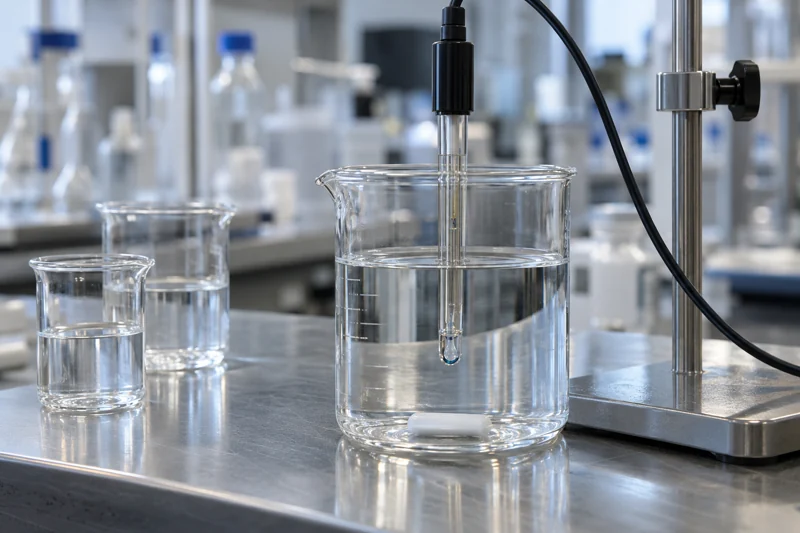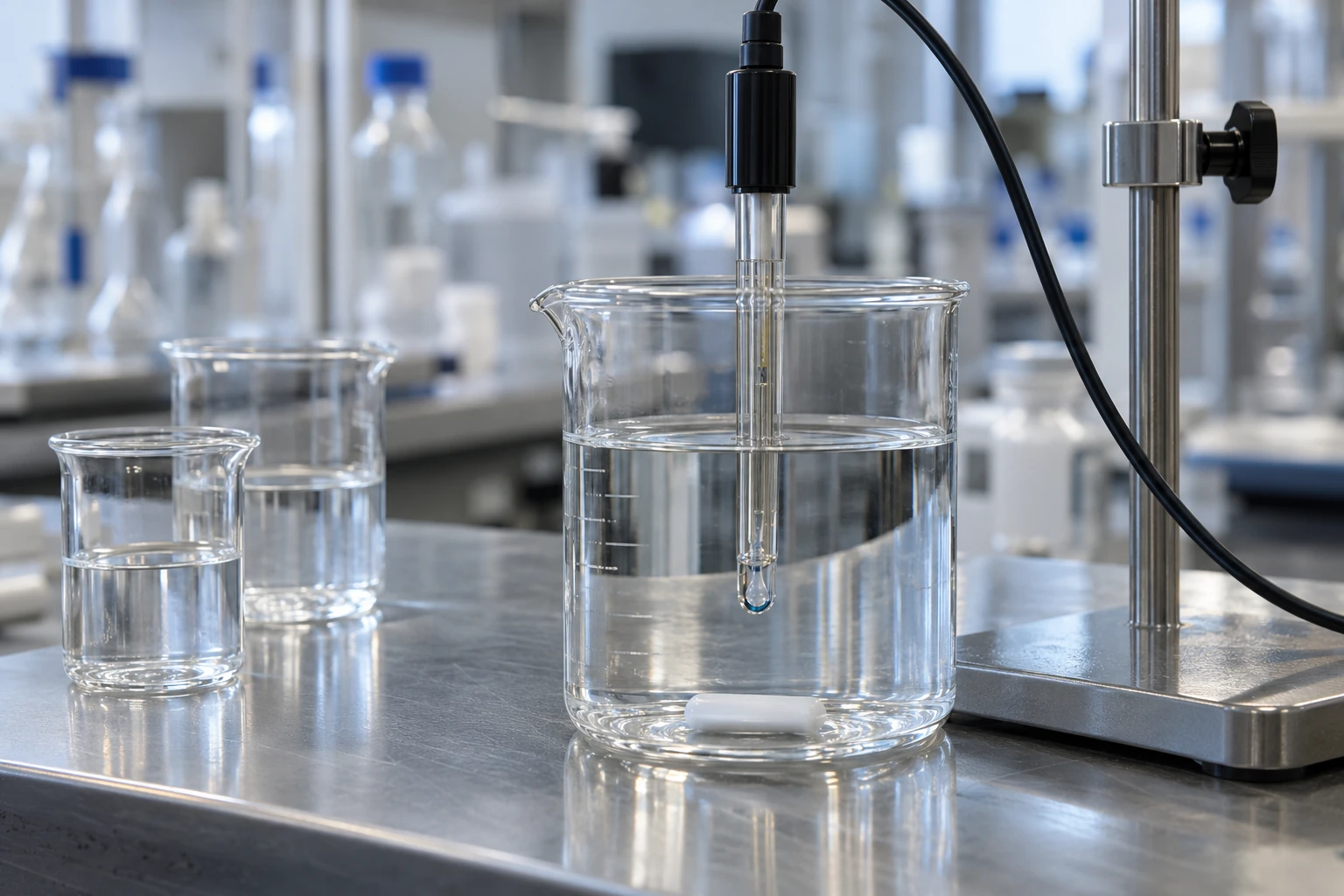
Hardness is a composition summary
In water chemistry, hardness usually means the combined contribution of dissolved calcium and magnesium. These positively charged ions often enter groundwater as water moves through mineral-bearing rock and soil. Other metals can contribute in some samples, but calcium and magnesium dominate the ordinary definition. This is a useful category because it connects a chemical composition to familiar effects: some soaps lather less readily, and mineral deposits may form on heated surfaces. [1]
The word does not describe how physically hard the water feels, and it is not another name for total dissolved solids. Dissolved sodium chloride can raise a water sample’s dissolved-solids content and conductivity without adding the calcium and magnesium that define most hardness. A hardness result therefore answers a narrower question than a general mineral-content or conductivity reading.
Why laboratories report “as calcium carbonate”
A report often gives hardness in milligrams per litre as calcium carbonate (mg/L as CaCO₃), even when the sample does not contain that concentration of solid calcium carbonate. It is a common chemical equivalent: calcium and magnesium amounts are converted to the amount of CaCO₃ that would represent the same charge capacity. Reporting one equivalent puts the two main contributors on a shared scale, so their contributions can be added and compared. A USGS-hosted laboratory procedure standardizes its EDTA calculation against calcium carbonate and reports hardness as CaCO₃ equivalents. [1] [2]
For example, a hypothetical result of 120 mg/L as CaCO₃ does not mean 120 milligrams of chalk are suspended in each litre. It means the measured hardness has been expressed on the CaCO₃ reference scale. In dilute water, mg/L is numerically close to parts per million, but the report’s “as CaCO₃” qualifier still matters: omitting it can make unlike measurements look interchangeable.
A titration counts binding capacity
One established laboratory approach uses EDTA, a molecule that binds calcium and magnesium ions. In the USGS procedure, the sample is buffered near pH 10 and combined with a color indicator. As measured EDTA is added, it complexes the target ions; the indicator changes from wine red to blue at the endpoint. The volume needed to reach that endpoint is used to calculate total hardness. This is a chemical measurement, not a visual estimate of scale or soap performance. [2]
The method also shows why a number depends on a procedure. Other metal ions can consume EDTA or blur the color endpoint, and suspended or colloidal material can interfere. A trained lab manages these effects with method-specific steps and quality controls. A home strip may be useful for a rough comparison, but its resolution, interferences and reporting scale are not automatically equivalent to a laboratory result. For a decision with consequences, check the test method and ask the lab what the stated uncertainty means.
Hardness and alkalinity overlap only partly
Hardness and alkalinity are different measurements. Hardness mainly tracks calcium and magnesium; alkalinity describes a sample’s capacity to neutralize added acid, commonly through bicarbonate and related bases. Natural waters often contain both calcium and bicarbonate because of the minerals they contact, so the values can rise together. That correlation is not an identity: a water can have hardness that exceeds its alkalinity, or alkalinity that exceeds its hardness. [1] [4]
This distinction helps explain why “hard water” is not simply water with a high pH. A pH reading reports the current acid–base condition, while hardness describes a set of dissolved ions. Neither number can be substituted for the other. If the practical question is corrosion, scaling or acid-neutralizing capacity, identify which property the relevant guideline or process actually uses.
The categories describe nuisance potential, not danger
USGS gives general categories of 0–60 mg/L as CaCO₃ for soft water, 61–120 for moderately hard, 121–180 for hard and above 180 for very hard. These bins are convenient descriptors, not sharp chemical transitions: water at 120 and 121 mg/L will not suddenly behave differently in every appliance or soap. A local utility report or direct test is more useful than a broad regional map when comparing a particular tap. [1]
Hardness can cause deposits and interfere with soap, but that does not make a hardness result a comprehensive safety test. USGS says hardness itself is not a health concern, and its water-quality FAQ notes that EPA has not set a federal legal limit for hardness. This narrow statement should not be stretched to mean a water supply is safe overall: pathogens, lead, nitrate and other contaminants require their own monitoring and standards. [1] [3]
Choose the measurement for the question
If a kettle develops scale, a hardness result can help explain why calcium-carbonate deposits are plausible, though water temperature, alkalinity and other conditions also affect precipitation. If soap leaves residue, hardness may be relevant, but product formulation and washing conditions matter too. If the concern is a specific contaminant, ask for that analyte rather than inferring it from hardness, conductivity, taste or a clear appearance.
A useful report keeps the measurement in context: sample location and date, units, method and any comparison threshold. For household decisions, begin with the local water supplier’s report or a properly collected sample analyzed by a qualified laboratory. The central lesson is simple: hardness is a compact description of particular ions. Its value comes from interpreting that description accurately, while leaving other water-quality questions to measurements designed to answer them.
Water hardness mainly summarizes dissolved calcium and magnesium, usually as an equivalent concentration of calcium carbonate. It helps explain soap response and mineral scale, but it does not reveal every dissolved substance, establish pH or diagnose a health risk. Match the test to the question you need answered.
Sources & further reading
Numbered references connect claims to their source. The main text is our original explanation; conceptual examples are identified as imagined.
- U.S. Geological Survey — Hardness of WaterGovernment · definition, common effects and general classification · 24 August 2026
- Albuquerque Bernalillo County Water Utility Department — Total Hardness: EDTA Titration Procedure (archived in a USGS report)Municipal water utility laboratory procedure · titration principle and interferences · revision 3, May 2006
- U.S. Geological Survey — Water-Quality Information: Frequently Asked QuestionsGovernment · hardness categories and federal standard status
- USGS Water Science School — Alkalinity and WaterGovernment · acid neutralization and buffering
Source review: 23 Nov 2026. Editorial standards.