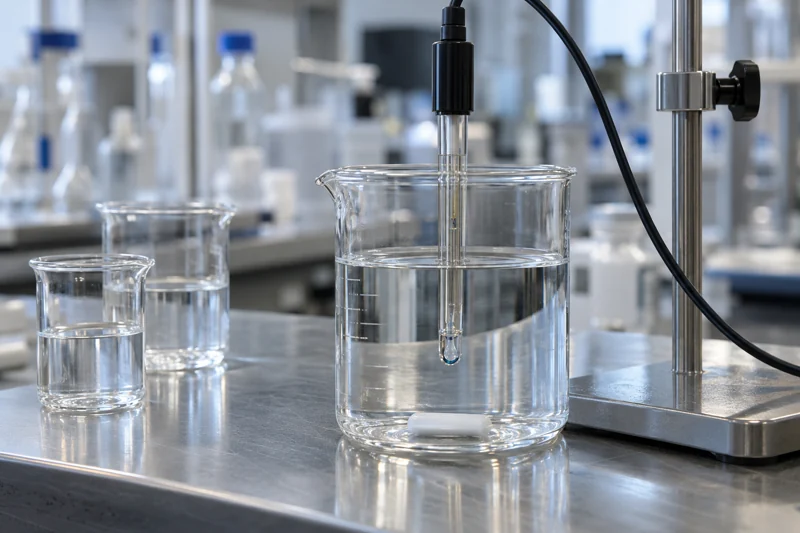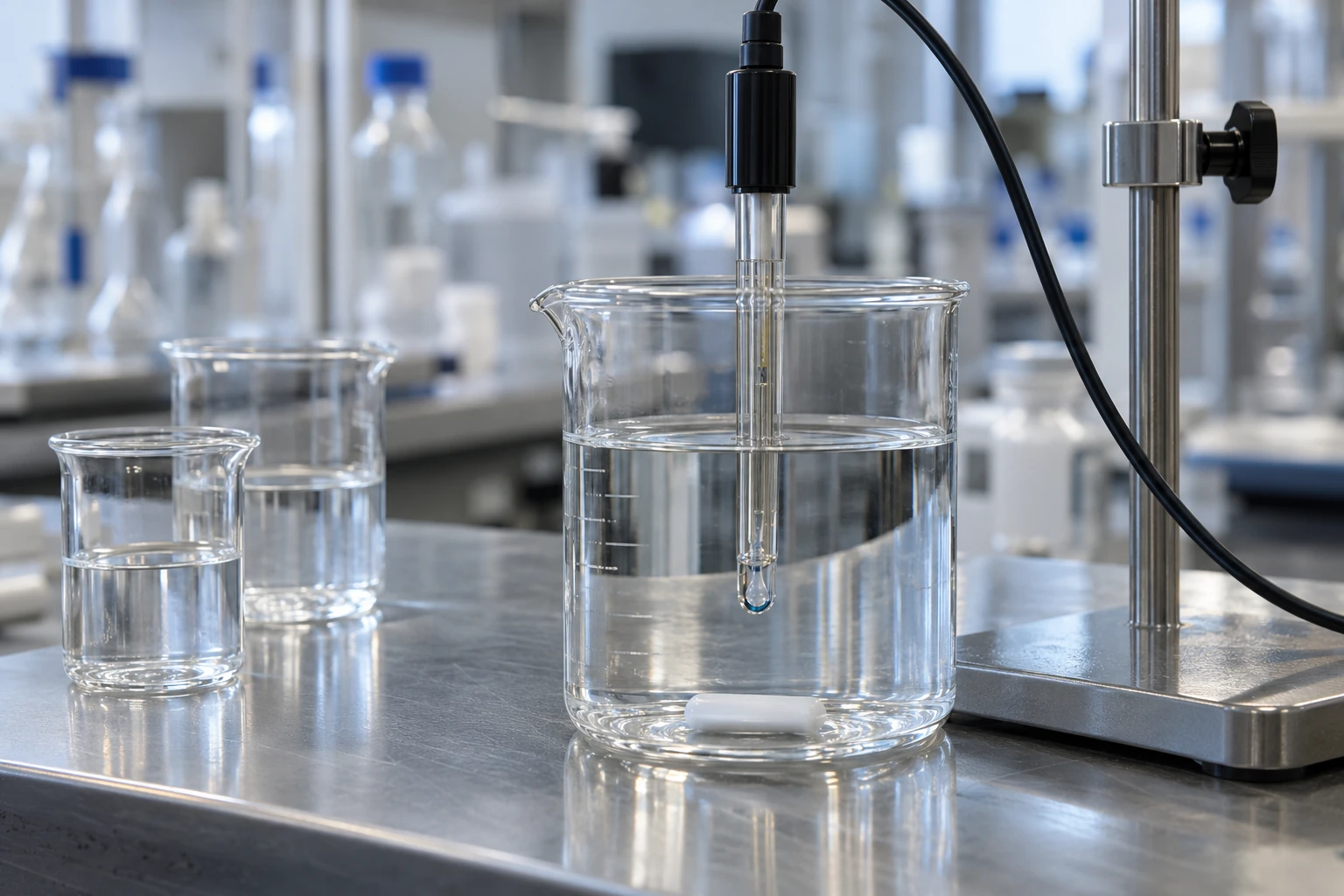
A meter senses moving charge
Pure water is a poor electrical conductor compared with ordinary tap, stream or seawater because those waters contain dissolved ions. When an electric field is applied across a conductivity cell, positively and negatively charged ions move in opposite directions and carry current through the liquid. The sample remains close to electrically neutral overall: conductivity does not mean the water has acquired a net charge. The USGS defines conductance as the inverse of resistance and conductivity as conductance normalized for cell geometry. [1]
A meter’s electrodes and cell geometry matter because a short, wide path through a liquid conducts differently from a long, narrow one even when the liquid is identical. Instruments account for geometry through a cell constant, then report conductivity in units such as microsiemens per centimeter (µS/cm).
More ions often raise the signal, but identity matters
Adding a soluble ionic compound commonly increases conductivity because it supplies more charge carriers. But equal masses of different salts need not produce equal readings. Dissolution can yield different numbers and charges of ions, and the ions differ in how readily they move through water. The USGS field manual therefore describes specific conductance as an indirect measure of the collective concentration of dissolved ions and notes that it varies with ionic species as well as amount. [1]
Imagine two clear samples with the same conductivity. One could contain mostly sodium and chloride ions, while another contains a different mixture of bicarbonate, calcium or other charged species. The meter cannot distinguish those compositions from a single bulk reading. Conversely, some dissolved substances that remain as neutral molecules contribute little directly to electrical current. Conductivity is consequently useful for screening and tracking changes, but a high or low value alone does not identify a contaminant, establish potability or describe every dissolved chemical.
Temperature changes ion transport
Warmer water usually conducts better because ions move more readily as the liquid’s viscosity falls. A sample measured at 30 °C can therefore show a higher raw conductivity than the same sample at 20 °C, even if its composition has not changed. USGS reports that conductivity may rise roughly 0.5–3 percent per degree Celsius depending on the ions present. Field meters commonly compensate by estimating what the reading would be at a reference temperature, often 25 °C. [1]
For a simple illustration, suppose a meter reads 1,000 µS/cm at 20 °C and uses a linear compensation factor of 0.020 per °C. The USGS equation gives κ25 = κ/[1 + α(t − 25)], or about 1,111 µS/cm. This is a model-based correction, not a second measurement. The manual says common compensation approaches work for many natural waters but can produce large errors in very acidic water; unusual composition and pH call for extra care. Check whether a displayed value is raw conductivity or temperature-corrected specific conductance before comparing it with another result. [1]
Conductivity is not a universal TDS conversion
Water-quality instruments often use conductivity to estimate total dissolved solids (TDS), but the estimate requires a relationship between conductivity and dissolved mass. That relationship changes with the mix of ions: a given mass concentration does not have one universal conductivity, and a given conductivity does not map to one exact dissolved-solids concentration. The USGS presents conductometric measurement as a way to estimate TDS in natural waters, while also describing conductivity as an indirect measure of dissolved ions. Treat a meter’s “TDS” display as a conversion based on an assumed factor unless the manufacturer or method documents a sample-specific calibration. [1]
A practical example is comparing a stream before and after a storm. A change in specific conductance can flag a change in the aggregate ionic signal and help decide when laboratory sampling is useful. It cannot by itself tell whether the cause was road salt, mineral weathering, wastewater, dilution or another process. Pairing conductivity with location, flow, temperature and targeted chemical analyses turns a screening observation into a better-supported interpretation.
Reliable comparisons start with the measurement
USGS field procedures emphasize timely measurement because precipitation, adsorption, gas loss and other processes can change water chemistry after collection. The agency recommends checking calibration with standards, allowing the probe to equilibrate, keeping the cell clean and recording the conditions and instrument information. [2]
NIST’s Standard Reference Materials include potassium-chloride solutions assigned conductivity values for calibrating and standardizing conductivity cells and meters. A standard check does not prove that a water sample has a particular composition; it tests whether the instrument responds appropriately to a known reference under specified conditions. [3] Follow the meter’s procedure, rinse as directed, avoid trapped bubbles, record temperature and compensation settings, and compare like with like.
Read the number as one piece of evidence
Conductometry is the measurement of a solution’s electrical conductivity, and IUPAC notes that the value depends on both the concentration and the nature of the ions present. That short definition captures the central limit: conductivity is sensitive to mobile charge, not uniquely to a named chemical. [4]
A useful report therefore states the unit, reference temperature, whether the value was corrected, sample location and date, and any relevant calibration or field conditions. Use conductivity to compare well-matched samples, follow a trend or identify an anomaly. When the question is “which ions?”, “how much chloride?” or “what is the regulatory concentration?”, use a method that measures those quantities directly. The meter’s strength is speed and sensitivity to aggregate ionic change; good interpretation begins by keeping that scope visible.
Conductivity measures how readily a solution carries electrical current through mobile ions. Compare measurements only with temperature, calibration and sample context in view; use ion-specific or gravimetric analyses when you need composition or a defensible dissolved-solids value.
Sources & further reading
Numbered references connect claims to their source. The main text is our original explanation; conceptual examples are identified as imagined.
- U.S. Geological Survey — Chapter A6.3: Specific ConductanceUSGS National Field Manual · measurement principles, temperature compensation and limitations · 2019
- U.S. Geological Survey — Collecting and Processing Stream Water Samples: Field AnalysesUSGS field protocol · specific-conductance measurement, calibration and sample handling
- National Institute of Standards and Technology — Standard Reference Materials Catalog, Electrolytic ConductivityNIST Standard Reference Materials catalog · conductivity calibration materials
- IUPAC Gold Book — ConductometryIUPAC Compendium of Chemical Terminology · current definition and note on ion concentration and identity
Source review: 22 Nov 2026. Editorial standards.