Dissolved material has not disappeared
When a crystal dissolves, its particles separate and become surrounded by solvent molecules. They remain in the liquid even when the mixture looks clear. A solution is not empty of solute; its dispersed particles are too small to see individually.
The amount that can dissolve depends on the particular solute, solvent and conditions. OpenStax defines solubility as the maximum concentration reached at equilibrium under specified conditions. That last phrase matters: solubility is not a universal number detached from temperature, pressure or the liquid. [1]
Saturation is an equilibrium condition
An unsaturated solution can dissolve more solute at the stated conditions. A saturated one has reached its equilibrium limit. If excess solid is present, particles continue to leave the solid and enter solution while dissolved particles return to it. At equilibrium, those opposing processes balance, so the solid amount and dissolved concentration remain steady. [2]
Saturation does not require a visible layer of undissolved material. A sample may be saturated even if no crystal remains. Conversely, cloudiness can come from suspended particles or droplets; it does not identify a dissolved compound or prove that a solubility limit has been crossed.
The ion product turns a limit into a comparison
For a sparingly soluble ionic solid, imagine MX(s) ⇌ M⁺(aq) + X⁻(aq). Its solubility product, Ksp, describes the equilibrium relationship among dissolved ions; the pure solid is omitted. For this one-to-one example, the introductory concentration form is Ksp = [M⁺][X⁻]. Other formulas use powers from the balanced dissolution equation. [2]
The reaction quotient Q uses the same form but with current ion concentrations. In the simple model, Q below Ksp means more solid can dissolve; Q at Ksp is the saturation boundary; Q above Ksp means precipitation is favored until the mixture moves back toward the boundary. This predicts direction, not how quickly crystals form or how large they become.
A worked example separates arithmetic from measurement
Imagine an invented one-to-one salt XY with a hypothetical Ksp of 1.0 × 10⁻⁸ in the chosen concentration convention. If a mixture contains 2.0 × 10⁻⁴ M X⁺ and 1.0 × 10⁻⁴ M Y⁻, Q = (2.0 × 10⁻⁴)(1.0 × 10⁻⁴) = 2.0 × 10⁻⁸. That exceeds the illustrative Ksp, so this model predicts precipitation is favored.
The values are a teaching exercise, not an observed salt or published result. A real prediction needs the correct dissolution equation, temperature-specific data and, sometimes, activities rather than concentrations. In a real mixture, dissolved ions interact, so concentration can be an imperfect stand-in for chemical activity. [2]
A common ion can lower how much dissolves
Suppose a saturated solution already contains one ion released by a solid. Adding more of that common ion changes the ion product. The balance can shift toward forming more solid, leaving a lower equilibrium concentration than in otherwise comparable pure water. OpenStax describes this common-ion effect in precipitation and dissolution systems. [2]
This is why “a salt dissolves to a fixed amount” is too simple. A new ingredient can alter the balance even if temperature and volume stay constant. Other reactions may bind an ion, change its chemical form or shift pH, so a direct common-ion calculation may not describe a complex sample by itself.
A supersaturated liquid can wait before it clouds
A supersaturated solution contains more dissolved solute than its equilibrium solubility under current conditions. It is a nonequilibrium state, but precipitation may not start visibly at once. A stable crystal nucleus can be difficult to form; a surface, dust particle or seed crystal can help crystallization start. OpenStax uses an opened carbonated drink as an example of supersaturated liquid releasing gas as bubbles. [1]
This delay separates thermodynamic favorability from kinetics. A clear supersaturated sample is not necessarily stable indefinitely, and a sudden burst of crystals does not mean the solubility limit changed at that instant. The starting point for crystal growth became available.
Temperature and pressure affect solutes differently
Temperature changes the equilibrium, but the direction depends on the material and whether dissolution absorbs or releases heat. For gases dissolved in liquids, warming commonly decreases gas solubility, while raising the gas pressure above the liquid increases it. Opening a carbonated drink lets carbon dioxide escape for this reason. Do not generalize those gas rules to every solid salt; its solubility data are needed. [1]
Mixing, evaporation and pH can matter too. Evaporation concentrates dissolved species; pH can change which ionic forms dominate; agitation can speed contact without changing the final equilibrium by itself. A careful explanation distinguishes a changed endpoint from a faster route to the same endpoint.
Household scale is a visible mineral example
USGS explains that hard water contains elevated dissolved calcium and magnesium, and that heating it can produce solid calcium carbonate deposits in heaters, pipes and coffee makers. Water can carry dissolved mineral ions before they reach a surface where conditions favor a solid deposit. [3]
This does not mean every hardness ion precipitates as calcium carbonate or every cloudy glass has the same cause. Hardness mainly describes calcium and magnesium, while scale formation depends on other chemistry. A national map gives regional context, not a diagnosis of an individual tap; local water-quality information is needed for a local conclusion. [3]
Clarity answers only one small question
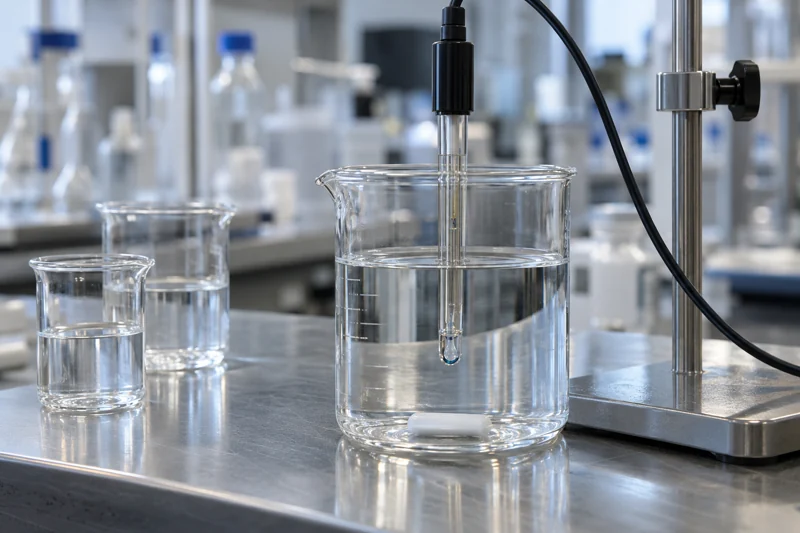
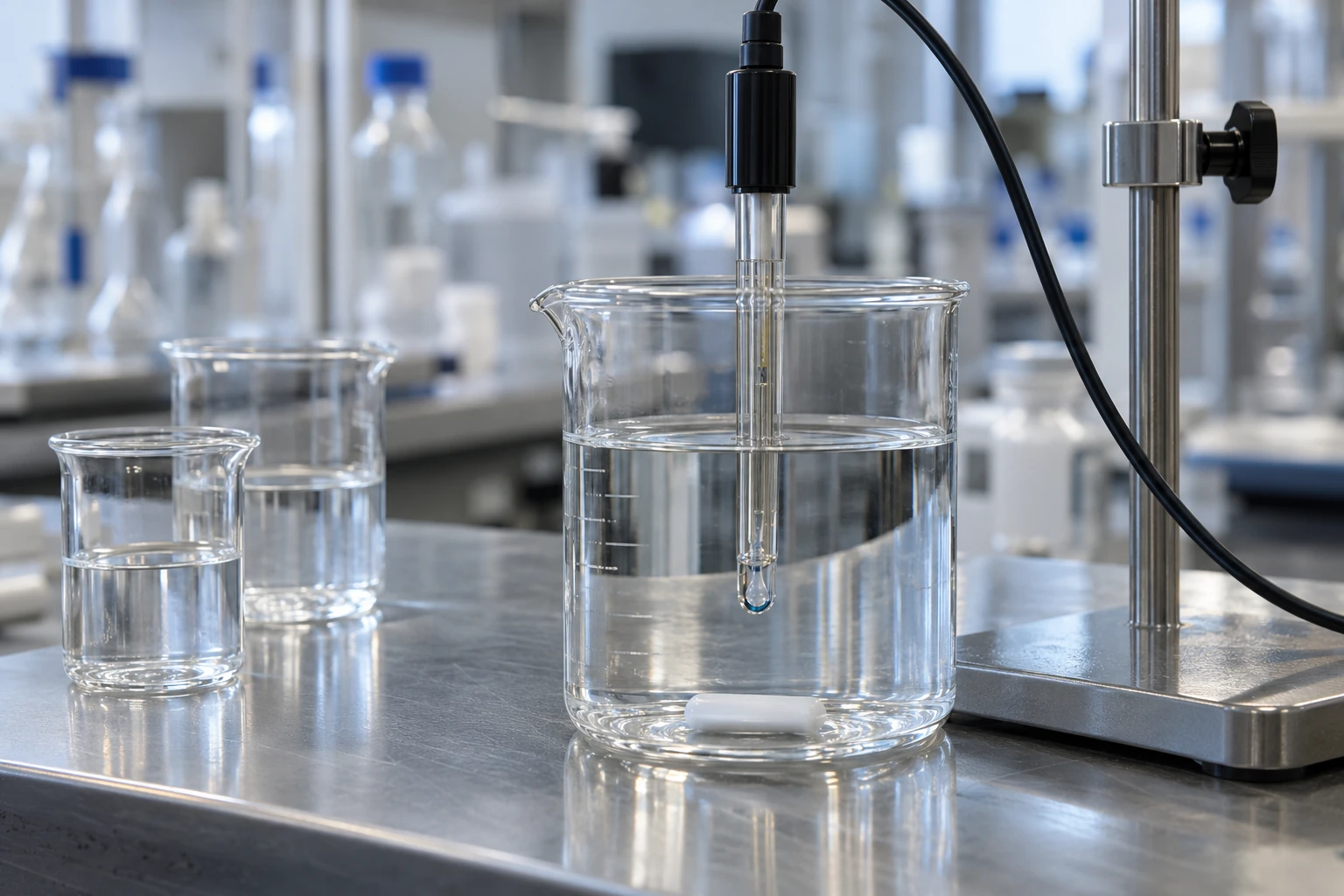
A clear sample tells an observer that no large amount of light-scattering material is obvious under those viewing conditions. It does not show how much invisible solute is present, whether the solution is close to saturation or whether an analyte is safe. Quantifying dissolved material needs an appropriate analytical method, calibration and sampling plan; a photograph cannot substitute for them.
When a solid appears, ask what dissolved species could form it, what changed in temperature, pH, pressure or concentration, and whether the solid was identified. Distinguish an equilibrium prediction from a measured result. Solubility organizes the question; chemical analysis establishes what a particular sample contains.
A solution can look clear while holding dissolved material near a condition-dependent limit. Temperature, pressure, additional ions and crystal formation can change whether material remains dissolved, so clarity alone does not measure total dissolved content.
Sources & further reading
Numbered references connect claims to their source. The main text is our original explanation; conceptual examples are identified as imagined.
- OpenStax Chemistry 2e — 11.3 SolubilityOpen textbook · saturation, supersaturation, gas solubility, temperature and pressure
- OpenStax Chemistry 2e — 15.1 Precipitation and DissolutionOpen textbook · solubility equilibrium, Ksp, ion product and common-ion effect
- USGS Water Science School — Hardness of WaterGovernment science explainer · water hardness and soap scum · updated 24 August 2026
Source review: 8 Nov 2026. Editorial standards.