A pH number is an activity scale
The pH scale is logarithmic: a one-unit difference corresponds to a tenfold difference in hydrogen-ion activity, the effective chemical quantity used to describe acid–base behavior. It is not simply a count of free hydrogen ions in every real solution. Our existing pH explainer introduces the scale; the practical question here is how a handheld meter assigns a number to a sample.
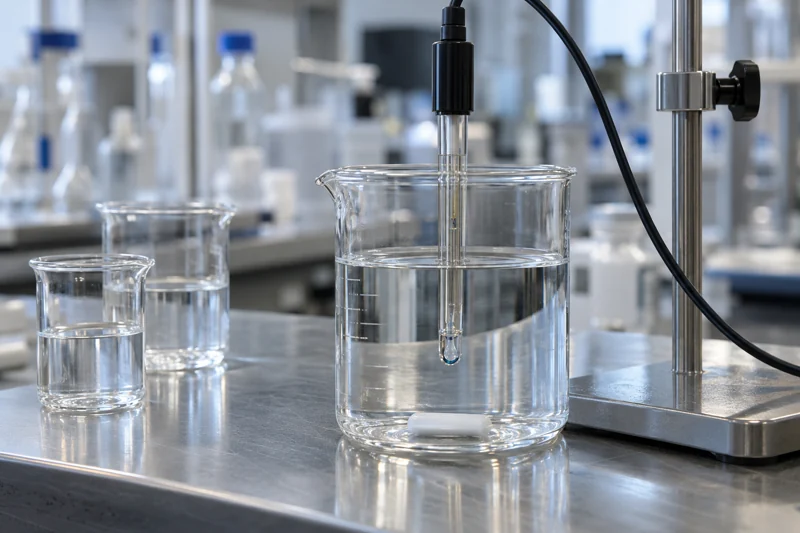
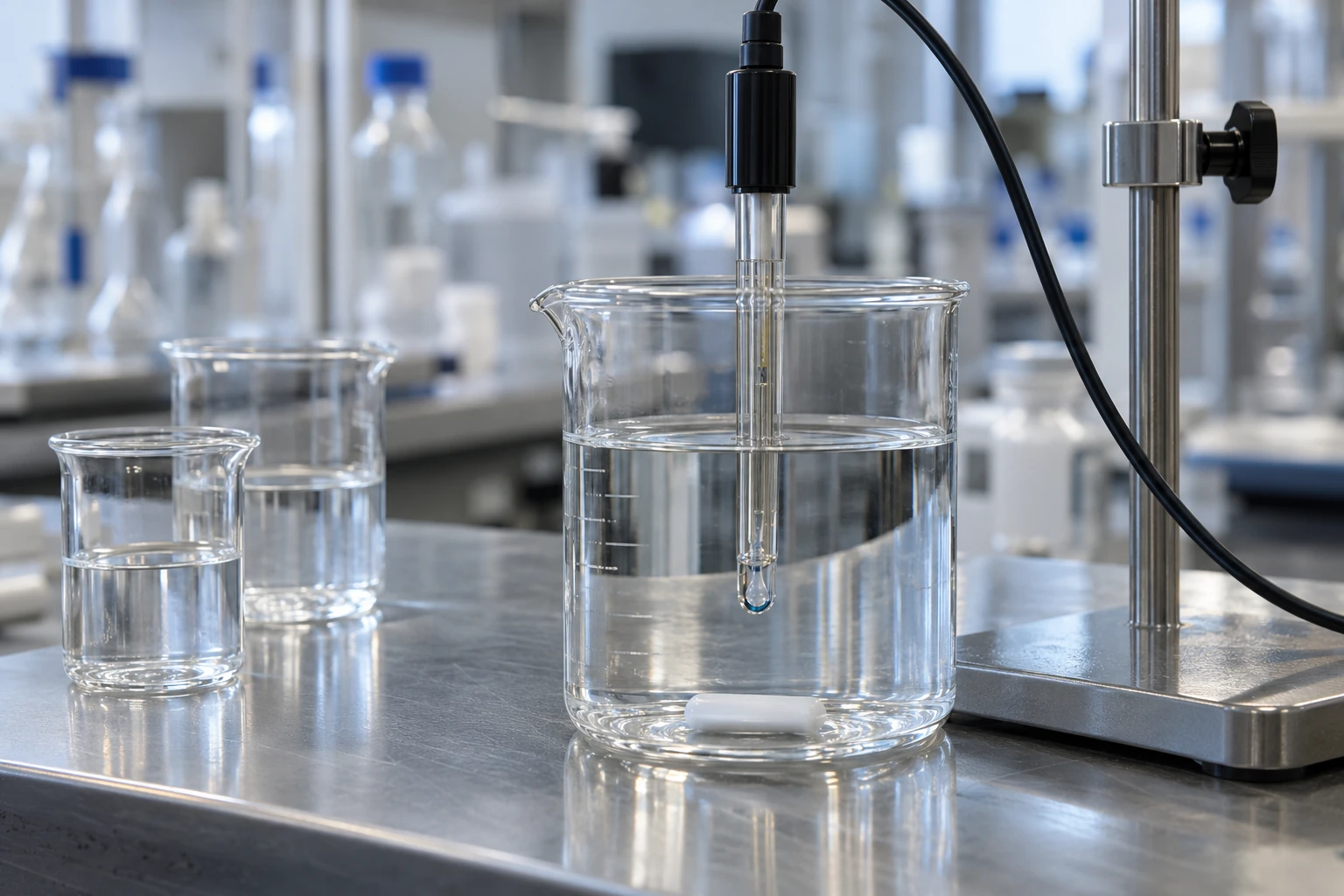
A common pH probe combines a thin, hydrogen-responsive glass membrane with a reference electrode. The two parts develop an electrical potential in the sample. The meter senses that voltage and converts it to pH using the electrode response established by calibration. The reading is therefore a measurement made by an instrument–electrode system, not a direct visual count of acidity. [1]
Calibration maps voltage onto the pH scale
A perfect electrode would have a predictable voltage change per pH unit. Real glass electrodes age, become contaminated or respond differently from the ideal. Calibration uses standard buffer solutions with assigned pH values to estimate the system’s offset and slope. A one-point adjustment can set an offset near one value, but it cannot adequately check how the response changes across a range. The WHO pharmacopoeial method calls for at least two buffers, preferably near and bracketing the sample, both to calibrate and to reveal a faulty response. [1]
Imagine measuring a sample expected near pH 6. A pH 4 and pH 7 buffer would bracket that target, allowing the meter to fit its response over a nearby interval. A second buffer is a check on the slope, not decorative confirmation that the display can be made to show a familiar number. If the electrode cannot read that independent buffer reasonably, the problem may be the electrode or the standards; repeatedly adjusting the first point can conceal rather than solve it. The precise acceptance limits depend on the measurement purpose and instrument procedure.
The buffer value depends on temperature too
Temperature affects two different parts of the measurement. First, it changes the voltage response expected from the electrode. Automatic temperature compensation (ATC) can adjust that slope when the temperature sensor is working and correctly connected. Second, temperature can change the sample’s own chemical equilibria and thus its actual pH. Correcting the electrode slope does not transform a warm sample’s chemistry into the pH it would have at room temperature. [2]
Calibration buffers also have temperature-dependent pH values. For example, the WHO table lists its phosphate buffer at pH 6.865 at 20 °C and 6.853 at 30 °C. That difference is small, but it shows why a meter must use the buffer value at its actual temperature rather than assume the label number applies unchanged. The USGS field procedure recommends bringing buffers and the sample to similar temperatures and applying the manufacturer’s correction information. ATC is useful, but it does not remove the need to record sample temperature or to equilibrate the measurement system. [1] [2]
A stable display is not always a stable sample
A meter may settle while the sample itself is changing. Water exposed to air can exchange carbon dioxide; gases can escape, solids can precipitate, and biological or chemical reactions can continue after collection. The USGS field manual warns that these processes can shift water pH within minutes or hours and recommends measuring promptly when dependable field-water results are needed. A steady number after a long delay may describe the altered sample rather than its original condition. [2]
Very dilute or weakly buffered samples pose another challenge: a small addition of contaminant, a rinse droplet or carbon dioxide absorbed from air can matter more than it would in a strongly buffered solution. The WHO procedure notes that unbuffered solutions may drift and require repeated portions before readings become reproducible. This is a limitation of the sample-and-measurement system, not necessarily proof that the instrument is defective. [1]
Calibration buffers do not perfectly imitate every sample
A standard buffer gives the meter a reproducible reference, but the reference and unknown may differ in ionic strength and composition. Those differences can affect the liquid junction between the sample and the electrode’s reference electrolyte. For ordinary comparisons in water, routine buffers are often suitable; for high-accuracy work or unusual matrices, the mismatch can become part of the uncertainty.
An IUPAC technical report examined glass-electrode calibration for seawater, a high-salinity matrix. It found that conventional low-ionic-strength buffers could produce sample-dependent differences and evaluated saline buffers designed to better match the medium. The lesson is bounded: it does not mean routine tap-water readings are invalid, nor that every sample needs custom standards. It means a calibration is strongest when its standards and procedure fit the sample matrix and required accuracy. [3]
A practical measurement sequence
For a routine aqueous sample, start with the meter and electrode instructions: probe designs and storage requirements vary. Select fresh standards that span the expected pH, check their temperature-dependent values, and calibrate with separate clean portions. Rinse the probe between solutions without returning used buffer to its stock bottle. Confirm the calibration with a buffer that tests the range, then rinse and measure the sample while allowing the response to stabilize. The USGS method also advises keeping the electrode clean and its reference junction functioning; its specific care steps are for field equipment and should not replace a manufacturer’s directions. [2]
As an imagined example, suppose a pond sample is expected to be mildly acidic. Calibrating at pH 7 and pH 4 brackets that region. If a fresh pH 4 check then reads outside the method’s tolerance, report no confident sample result yet: inspect the electrode, replace questionable buffer and recalibrate. If the display later settles near pH 6.2, record the temperature and sampling time as well. That one value is useful, but the context says what was measured and helps another person judge whether comparisons are fair.
Report the conditions along with the value
A useful pH record includes the sample identity, collection and measurement time, sample temperature, calibration buffers and temperature, and any instability or unusual matrix conditions. Replicate readings can reveal repeatability, but repeating the same biased setup does not remove a systematic error. The USGS recommends quality checks and recording measurement methods and anomalies; formal studies should define their own acceptance criteria for precision and accuracy. [2]
The displayed decimal places are not a guarantee of accuracy. Calibration establishes a traceable comparison only to the extent supported by the standards and procedure; electrode condition, sample changes and matrix effects remain relevant. Treat pH as a well-defined measurement with a stated context, rather than a context-free property that a meter reveals automatically.
A pH meter converts electrode voltage into a calibrated estimate; temperature, sample changes and matrix mismatch still shape what that estimate can support.
Sources & further reading
Numbered references connect claims to their source. The main text is our original explanation; conceptual examples are identified as imagined.
- The International Pharmacopoeia, 13th edition — 1.13 Determination of pHWorld Health Organization pharmacopoeial method · glass-electrode calibration, temperature-dependent buffers and measurement limitations
- U.S. Geological Survey — National Field Manual, Chapter A6.4: Measurement of pHUSGS field-methods chapter · calibration, temperature, electrode care, sample handling and quality checks · Version 1.3 (2006)
- Millero et al. — Feasibility of multifunction calibration of H+-responsive glass electrodes in seawaterIUPAC technical report · primary study of calibration and uncertainty for saline seawater buffers · 2021
Source review: 28 Nov 2026. Editorial standards.