A point-of-care test is a chain of chemical decisions
A diagnostic result begins before a sensor produces a number. The sample has to enter the device, reach the right reaction zone, meet reagents in a controlled order and generate a signal that can be interpreted. A device may work well at one step and still fail as a complete test: a highly sensitive reaction is of little use if fluid misses the chamber or the readout changes with lighting.
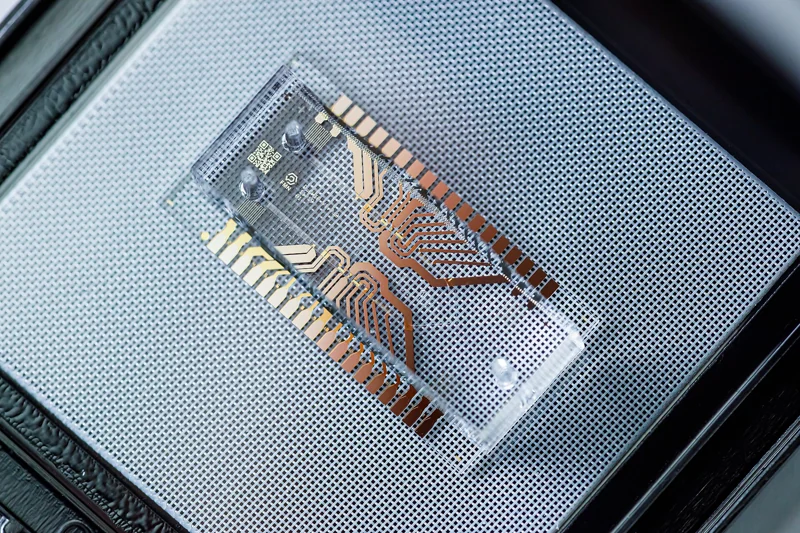
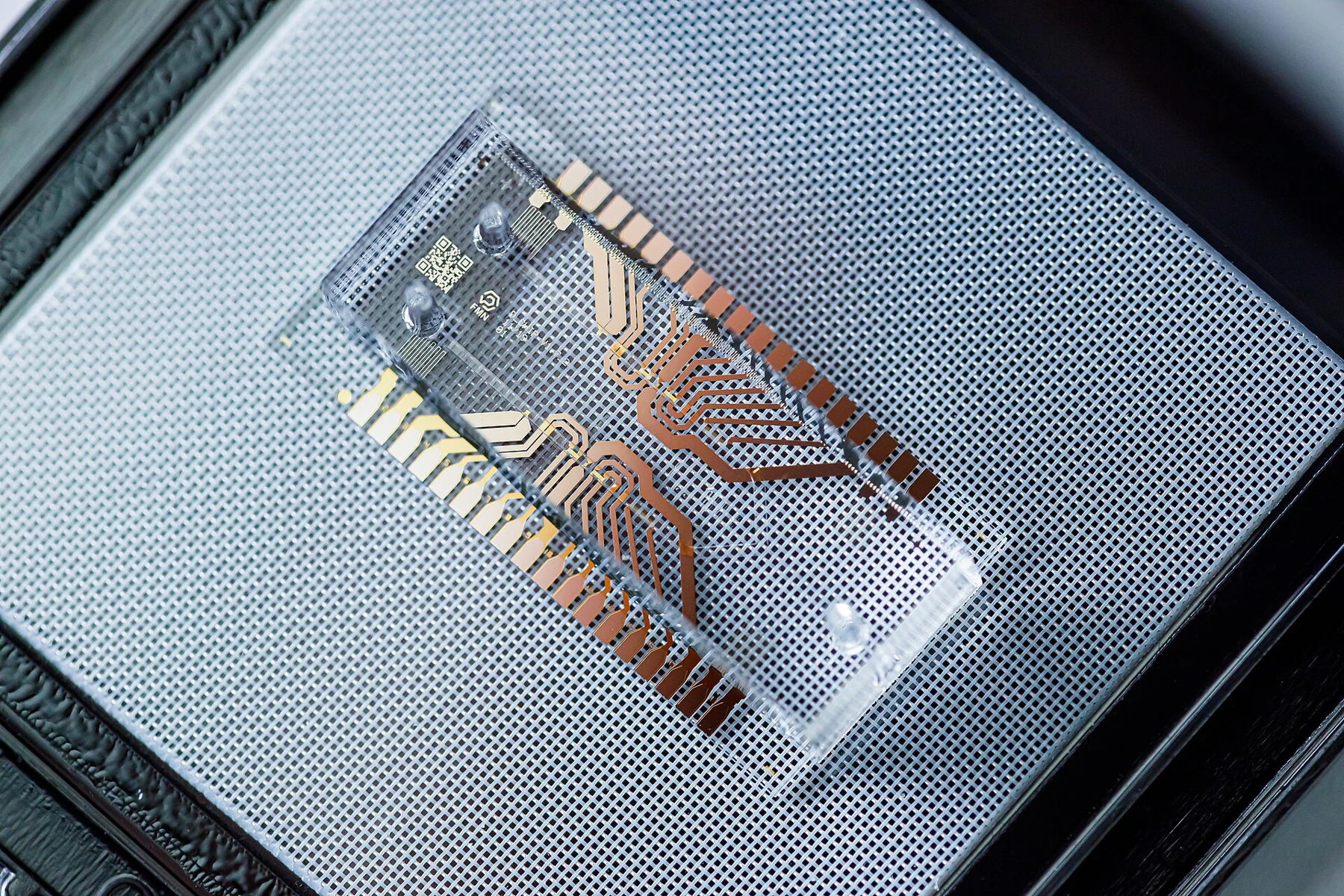
A Nature Communications study published on 5 October 2026 presents SID-WAVES, short for Smartphone-Integrated Diagnostics with Wax-encoded Amplified and Versatile Evaluation System. The researchers designed a microfluidic platform to coordinate nucleic-acid and protein tests and return results through a smartphone. The work is useful to read as an engineering study of how fluid handling, assay chemistry and image interpretation can be connected. [1]
Wax and siphons act as timed switches
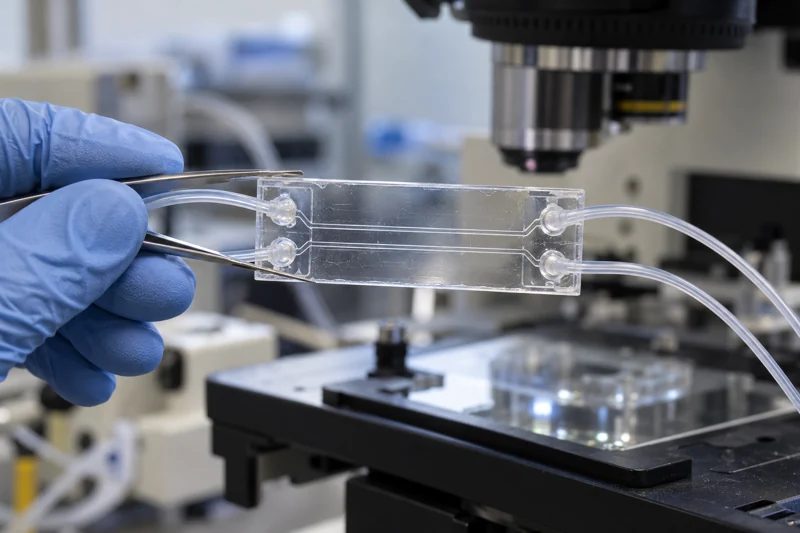
The device uses low-melting-point phase-change material and dual-siphon valves. In general terms, a phase-change valve can block or permit a path as a material changes state, while a siphon can transfer liquid after it reaches a defined priming condition. Together, such features can help control where liquid goes and when a reaction mixture advances, without requiring a separate manual pipetting action at every step.
That timing matters because the platform combines reaction types with different requirements. Its nucleic-acid workflow uses recombinase polymerase amplification (RPA) alongside CRISPR-associated Cas12a detection. Amplification increases the number of target sequences available to detect; guide-directed Cas12a activity then helps generate a detectable signal. The paper also describes protein immunoassays, which rely on selective binding rather than copying a nucleic-acid target. The device architecture is therefore coordinating unlike chemistries, not simply running the same test in several lanes. [1]
Multiplexing needs an address for every signal
A test that measures several targets faces a bookkeeping problem: signals must stay associated with the correct sample and target. SID-WAVES uses spatial, temporal and signal encoding, so location, sequence and measured output help distinguish results. This is a physical and analytical design strategy. If two targets produce similar colors, for example, assigning them to separate positions or reading at defined times can reduce ambiguity, provided the layout and analysis remain reliable.
The authors report a reconfigurable framework in which assay panels can be changed by swapping target and probe components. That is a meaningful design goal because disease panels vary. But reconfigurability creates new validation work: every changed target, probe, reagent lot or specimen type may alter sensitivity, interference and interpretation. A programmable platform does not make all possible panels validated by default. [1]
The headline numbers describe different experiments
The study reports attomolar-level sensitivity, stated as 10⁻¹⁸ molar, and greater than 95% diagnostic accuracy across 225 clinical and self-collected molecular assays. The abstract describes these as assays; that figure should not be mistaken for 225 independent people or for a population-wide clinical trial. Sensitivity at a concentration level and accuracy across tested assays are also different metrics. Neither alone tells a reader how false positives and false negatives behave in every intended-use population. [1]
For protein testing, the paper reports a three-part amplification strategy and hierarchical capture. It says this increased sensitivity 125-fold and raised accuracy from 87.6% to 100% in 54 simulated samples. The simulated-sample qualifier is central: the result shows performance in that evaluation set, not a measured improvement in patient outcomes or evidence across routine clinical practice. The abstract’s high figures are reasons to examine the method, not substitutes for the details of its comparison groups and intended use. [1]
A worked example separates detection from a decision
Imagine a platform reports a positive signal for one respiratory-virus target and a negative signal for a second target in a sample. The instrument has made two assay calls. To turn those calls into a clinical decision, a care team also needs to know how well each call performs for the relevant population, when the sample was collected, what symptoms or exposure mean, and whether an accepted confirmatory test is needed. The signal is an input to interpretation, not the whole decision.
The same logic applies to analytical sensitivity. A very low detection limit indicates that an assay can respond to small quantities under stated conditions. It does not by itself establish specificity, robustness to interfering substances, performance across operators or the consequences of a result near the threshold. Those are distinct questions that need suitable experiments.
A phone makes the reader portable, not automatically the test
A smartphone can provide a camera, computing and a familiar interface in one device. Image-analysis software may standardize how color or patterns are read, reducing some variation from visual judgment. But a camera still encounters differences in illumination, focus, exposure, device model and sample presentation. Calibration, locked analysis procedures and checks for out-of-range images matter if a numerical result is meant to be compared across settings.
Portability also includes the less visible parts of the workflow: reagent storage, power, waste handling, cartridge manufacturing, instructions, training and the route from result to care. WHO’s 2026 generic target-product profile treats diagnostic development as a fit between performance and the conditions in which a product is meant to be used. It distinguishes instrument-free tests, instrument-based point-of-care tools and laboratory-based testing contexts. [2]
The next evidence step is use-specific validation
A practical next study would define one intended use and compare blinded device results with an accepted reference method on an appropriately selected sample set. It would report the number and source of samples, the target-by-target confusion counts, invalid or repeated tests, operator training, and performance across sites and device lots. Testing should also challenge likely interferents and assess whether the signal remains stable during storage and transport. These are proposed evaluation steps, not results attributed to SID-WAVES.
WHO describes evaluation and prequalification as routes for assessing the safety and performance of diagnostic tests against relevant criteria, and maintains an essential in-vitro diagnostics list to guide availability. That institutional role is separate from a research paper’s demonstration of a platform. The study’s performance claims should therefore not be read as regulatory clearance, WHO recommendation or proof that the system is commercially available. [3]
What the platform contributes
SID-WAVES is notable for organizing nucleic-acid amplification, CRISPR detection, protein immunoassays and smartphone interpretation within a programmable microfluidic scheme. The reported work suggests that wax-based flow control and encoded signals can help combine assays that are often treated separately. That gives other researchers a design to interrogate and adapt.
The broader lesson is that miniaturization does not remove complexity; it relocates complexity into materials, channel geometry, timing and interpretation. A useful point-of-care system must make those steps dependable for a clearly specified use. The October paper provides evidence of a research platform with promising measured results. Further independent, use-specific validation would show how well that promise travels beyond the tested assays.
SID-WAVES demonstrates a way to coordinate multiple assay types on a smartphone-read microfluidic platform. Its reported results are a research-stage performance demonstration, not yet evidence of a broadly validated or WHO-prequalified diagnostic product.
Sources & further reading
Numbered references connect claims to their source. The main text is our original explanation; conceptual examples are identified as imagined.
- Xu et al. — Reframing decentralized diagnostics with a programmable multi-dimensional microfluidic systemResearch paper · Nature Communications · 5 October 2026
- World Health Organization — Target product profile: developing in vitro diagnostics for low- and middle-income settingsWHO technical standard · 19 July 2026
- World Health Organization — In vitro diagnosticsWHO overview · evaluation and essential diagnostics
Source review: 11 Nov 2026. Editorial standards.