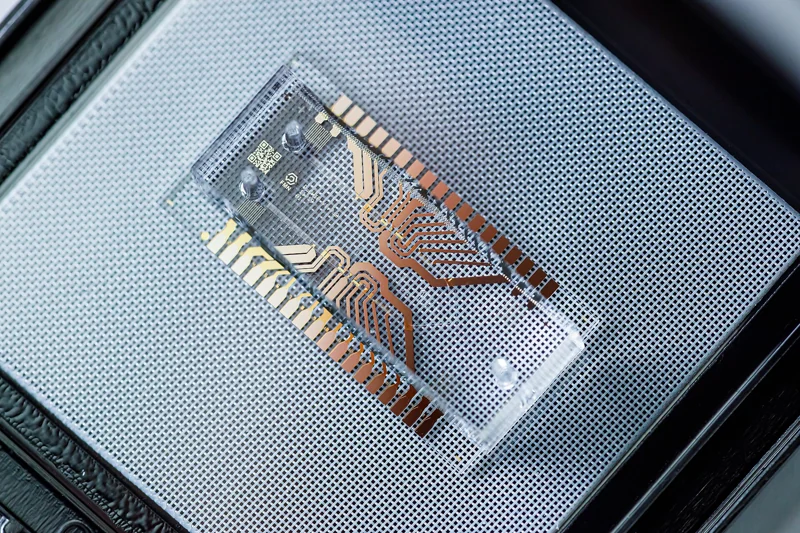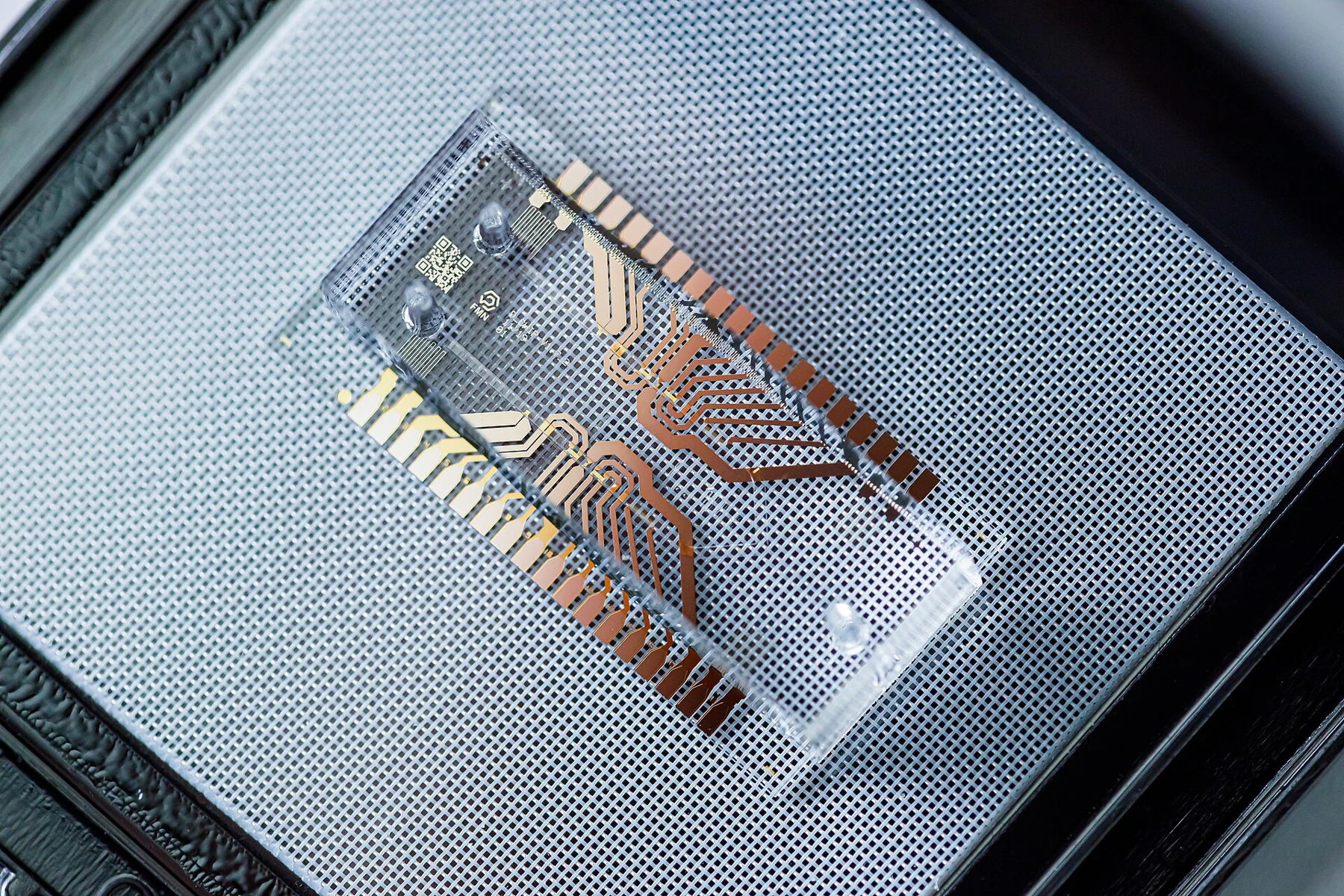
The interface supplies a pressure difference
A capillary channel does not pull liquid by suction in the everyday mechanical sense. At the front of the liquid, surface tension acts along a curved liquid–air interface. Curvature means pressure differs across that interface; the pressure on the liquid side can be lower than the pressure behind it, so surrounding pressure pushes liquid forward. In a narrow passage, the interface curvature can be substantial, making this small-scale effect useful even when gravity is unimportant.
Whether the meniscus advances also depends on how the liquid meets the solid. The contact angle describes the shape at that three-phase boundary. A lower angle generally indicates better wetting for the same liquid and surface. In a closed rectangular channel, the walls all contribute, so the pressure depends on the contact angles and on both channel width and height—not on a single material label such as “hydrophilic.” [1]
A useful model balances drive against resistance
The first design model is a force or pressure balance. Curvature and wetting provide capillary pressure; viscous friction in the channel opposes motion. In a simple cylindrical tube, the Lucas–Washburn picture predicts that the distance filled grows approximately with the square root of time. The front therefore moves quickly at first and progressively slows as a longer length of liquid creates more resistance. A rectangular microchannel needs a geometry-specific resistance and meniscus model, but the same competition remains: the interface supplies the drive, and the flowing liquid dissipates energy.
This distinction matters in a practical assay. A channel may begin filling spontaneously yet still take too long to deliver a sample to a reaction zone. “No pump required” describes the source of motion, not a guarantee of a chosen flow rate, complete filling or reproducible timing.
Surface treatment changes the boundary condition
A polymer channel’s wetting behavior can change with its surface chemistry. One experimental study used embossed polymethyl methacrylate (PMMA) channels and measured water contact angles from roughly 44° on air-plasma-treated material to about 80° on untreated PMMA. The researchers recorded faster water-front motion on surfaces with lower contact angles and slower filling when larger micropillars were added. The channel height was 33 micrometres, and the results belonged to those fabricated geometries and treatment conditions; they are not a universal calibration for every PMMA chip. [1]
This is why a surface modification that works on one batch can need rechecking after storage, bonding or a change in cleaning. Contact angle is a measured property of a particular liquid–surface pair and preparation state. It is a helpful quality-control indicator, not a complete prediction of device performance.
The moving contact angle may differ from a droplet test
A static droplet photographed on a flat coupon is not the same situation as a meniscus advancing through a channel. During motion, the apparent contact angle can depend on speed. A 2024 study examined several liquids in open PMMA channels and found that including a dynamic contact angle improved the account of early, faster penetration; the effect was especially relevant in the open-channel geometry. Its experiments also found that a molecular-kinetic model represented the measured liquids more accurately than the alternatives tested. [2]
The practical lesson is modest but important: static wettability measurements help compare surfaces, while time-resolved filling tests check the actual device. The 2024 result concerns the liquids, geometry and speed range studied. It does not establish that one dynamic-angle model will fit all liquids or every channel design.
A worked comparison separates pressure from flow speed
Imagine an ideal circular tube with the same radius and liquid in two trials, but contact angles of 80° and 50°. The simplified capillary-pressure term is proportional to surface tension times the cosine of the contact angle, divided by radius. Since cos 50° is about 0.64 and cos 80° about 0.17, the idealized driving term is roughly 3.7 times larger in the 50° case. This is a teaching comparison, not a forecast that liquid will travel 3.7 times faster: channel resistance, changing angle, entrance effects and actual cross-section all shape the observed motion.
In a real rectangular chip, a useful comparison records the meniscus position against time for the same liquid volume, channel dimensions, orientation and temperature. A second set can vary only the surface treatment. If filling changes, microscopy and contact-angle checks can help distinguish a wetting change from a fabrication defect or a geometric obstruction.
Design for the whole filling path
Corners, expansions, pillars, roughness and bends can pin or slow a front even if the straight channel wets well. A sudden widening changes the shape of the meniscus; a narrow gap may increase viscous resistance; trapped air can block a closed passage. Open channels avoid some bubble problems and make surfaces accessible, but their exposed interface changes the flow model and can increase sensitivity to evaporation or contamination.
Capillary flow is most useful when the device is designed around the sample and the measurement, then checked with the intended liquid and manufacturing process. The governing idea is simple—surface tension can create a pressure difference—but dependable operation requires matching that drive to channel resistance and to the behavior of the moving contact line.
A curved liquid–air interface creates a pressure difference that can pull a wetting liquid into a small channel. Surface treatment and geometry tune that drive, while viscosity, roughness, obstacles and dynamic wetting limit how quickly filling occurs.
Sources & further reading
Numbered references connect claims to their source. The main text is our original explanation; conceptual examples are identified as imagined.
- Mukhopadhyay et al. — Nanoscale surface modifications to control capillary flow characteristics in PMMA microfluidic devicesPrimary experimental research · PMMA microchannels, wettability and capillary filling
- Tokihiro et al. — On the dynamic contact angle of capillary-driven microflows in open channelsPeer-reviewed primary research · Langmuir · published 21 March 2024
Source review: 20 Nov 2026. Editorial standards.