Small channels change which physical effects matter
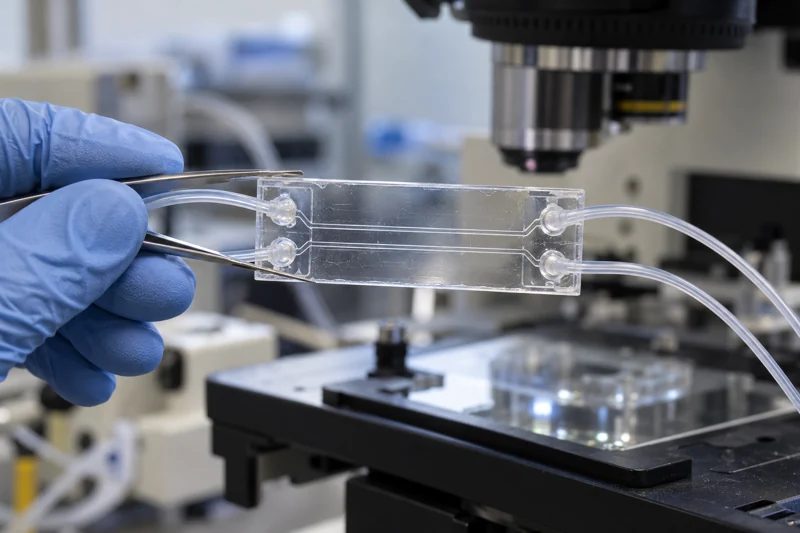
A microfluidic device moves or holds small amounts of fluid in channels with small cross-sections. The important change is not just that the apparatus uses less sample. Reducing the characteristic distance can change the balance between viscosity, inertia, diffusion and surface interactions. A process that works by vigorous stirring in a large vessel may need a different design inside a narrow channel.
This makes microfluidics useful for controlled chemical and biological experiments. Researchers can define where streams meet, how long a sample spends in a region and which surface it contacts. The device becomes part of the experimental conditions rather than just a smaller container. NIST's work on microfluidic flow measurement illustrates how closely the physics of transport and the reliability of an assay are connected. [1]
Why orderly flow can be both useful and inconvenient
The Reynolds number compares the relative importance of inertia and viscosity for a chosen flow situation. Its familiar form is Re = ρUL/μ, where ρ is density, U is a characteristic speed, L is a characteristic length and μ is dynamic viscosity. Making L small often leads to low Reynolds numbers, although the actual value also depends on the fluid and speed.
At low Reynolds number, streams can travel beside one another without the turbulent stirring familiar from a rapidly mixed beaker. This is useful when the aim is to expose cells to a stable concentration gradient. It is inconvenient when two reagents must mix quickly. Small dimensions do not automatically solve mixing; they make the distance over which molecular diffusion must act a central design choice.
A diffusion calculation makes the scale tangible
For a simple one-dimensional diffusion estimate, a characteristic time is t ≈ L²/(2D). Here L is the distance to be crossed and D is the diffusion coefficient. The formula gives a scale for transport, not a universal definition of complete mixing. Boundaries, flow and the chosen measure of uniformity affect the result.
Take an invented example with D = 1 × 10⁻⁹ square metres per second. Crossing 100 micrometres gives a characteristic time of about five seconds. Crossing one millimetre gives about 500 seconds. Increasing the distance tenfold increases the estimate a hundredfold. This calculation explains why bringing fluids into thin adjacent layers can be effective even when there is little turbulent motion. The site's diffusion tool lets readers explore the same relationship with different assumed distances and coefficients.
Residence time connects geometry with reaction opportunity
A fluid element has only a limited time inside a channel. In an idealized plug-flow estimate, residence time is channel volume divided by volumetric flow rate. A channel holding one microlitre with a flow of one microlitre per minute has a nominal residence time of one minute. These invented values illustrate a relationship, not the operating conditions of a particular experiment.
The real distribution of residence times can be broader because fluid near a wall may move differently from fluid near the centre. Diffusion can transfer molecules between those regions. A reaction that needs time to proceed must therefore be matched to transport and flow, not simply placed in a smaller vessel. Increasing throughput can shorten contact time unless geometry, parallelization or another part of the design changes.
The walls become a larger part of the experiment
A narrow channel exposes a large surface relative to the volume it contains. That can help when a reaction or measurement occurs at a wall. It can also cause problems if a protein or small molecule binds unintentionally to the channel material. In that case, the concentration delivered to the measurement region may differ from the concentration prepared at the inlet.
Material choice also affects optical access, gas transport, compatibility with solvents and the ability to attach cells. A device suitable for observing a cell layer is not automatically suitable for every chemical synthesis. The experimental question should determine which properties are important. A well-designed channel is useful because its interactions are understood and controlled, rather than because miniaturization makes the surrounding material irrelevant.
Continuous streams and droplets offer different tools
In continuous-flow devices, a sample moves through connected channels while its surroundings change along the route. In droplet-based systems, small compartments are formed within another fluid. Each droplet can act as a separate environment, making it possible to compare many small reaction volumes or partition a sample into many measurements.
Compartmentalization introduces its own requirements. Droplet volume and composition must be consistent enough for the intended comparison, while interfaces can influence the chemistry or biology inside. A high count of compartments is not automatically a high count of independent biological samples. If all droplets come from one preparation, they may share preparation-related errors. The choice between formats depends on the question, the required throughput and the measurement that will distinguish a meaningful result.
A small volume can still contain many molecules
Miniaturization changes sample amount, but “tiny” does not necessarily mean that only a few molecules are present. In an invented idealized example, a one-nanolitre sample at a concentration of one nanomole per litre contains about 600,000 molecules. The estimate follows from multiplying concentration by volume and then by Avogadro's constant.
Reducing concentration or compartment volume reduces that expected count proportionally. At sufficiently low counts, differences between compartments become an important part of the measurement rather than just instrument noise. This connects device dimensions with the statistics of sampling. A design that uses little material must still contain enough information-bearing molecules for the intended assay, or use a method that accounts for low-count behaviour.
A useful chip still needs an instrument around it
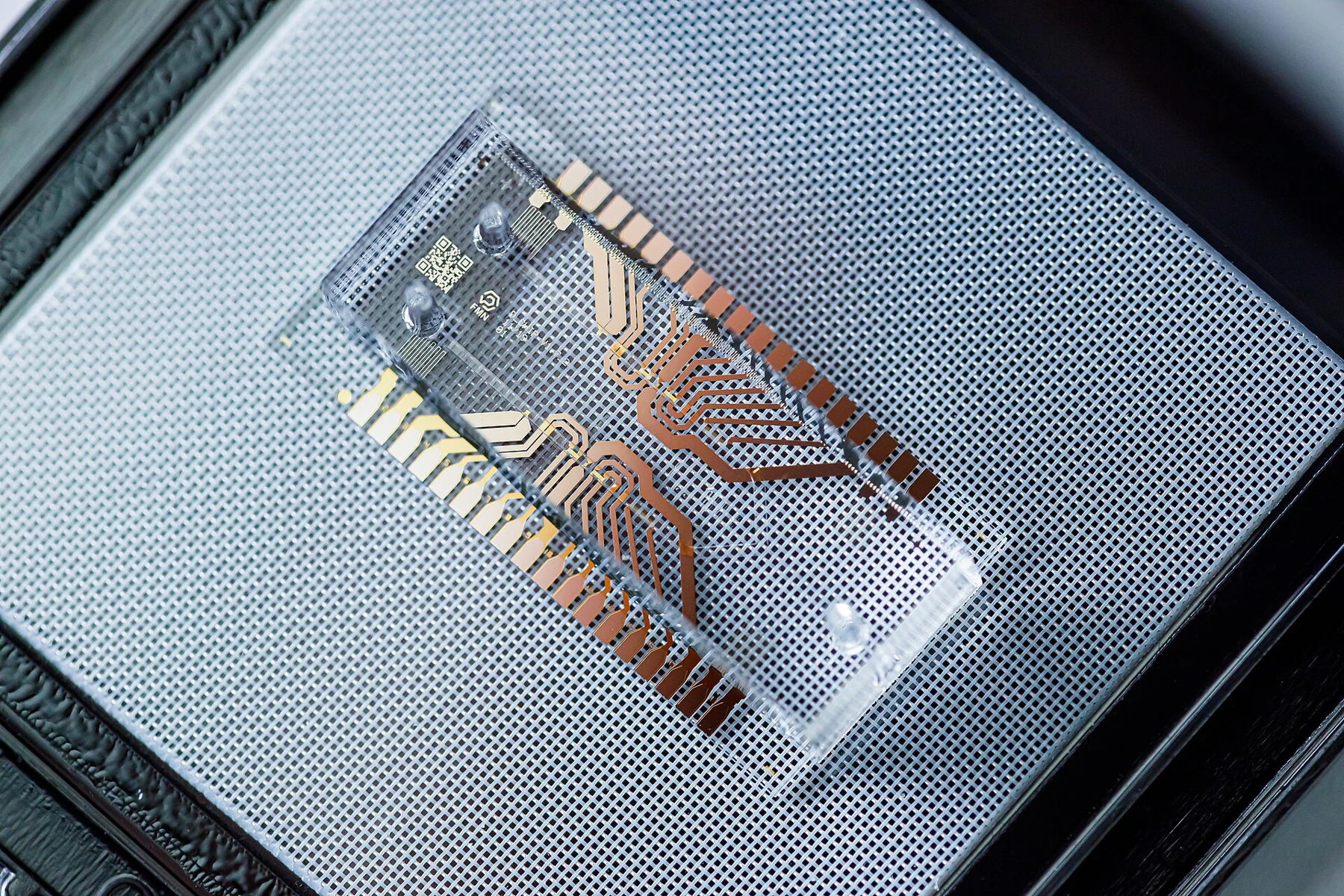
Channels require ways to introduce samples, control flow and collect information. Pumps or pressure sources, valves, tubing, temperature control and detectors may dominate the size and complexity of the final instrument. Bubbles, leaks or contamination can undermine a well-made channel. The phrase “lab on a chip” therefore describes an ambition for integration rather than proof that every laboratory function already fits on one small object.
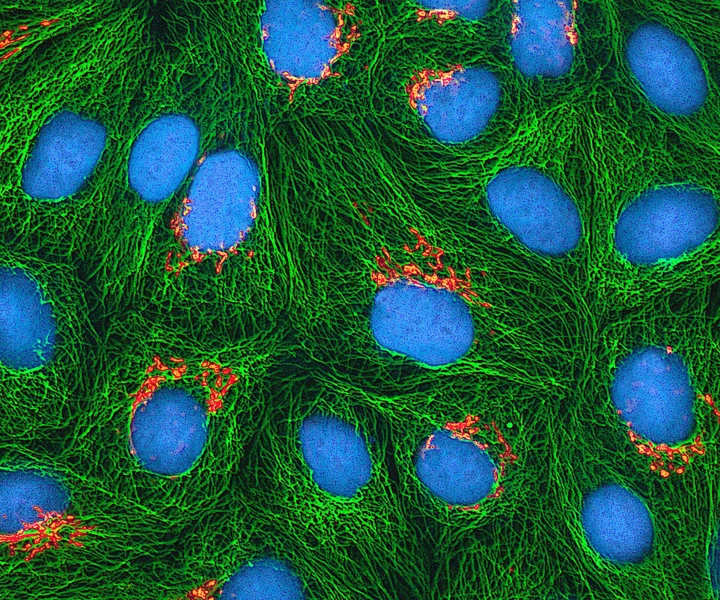
Organ chips show why this supporting system matters. Living cells need an appropriate environment while researchers monitor tissue behaviour. The fluidic device helps define exposure and transport, but maintaining and interpreting the tissue remains an additional task. The Wyss technology overview provides examples of this relationship between microengineering and biological modelling. [2]
What miniaturization can change outside the laboratory
Small fluid volumes can make limited samples go further and allow more conditions to be compared. Defined transport can improve the interpretation of a chemical or biological response. In a practical diagnostic or manufacturing process, those benefits must survive sample preparation, handling, quality control and operation by the intended user.
The original MicroTAS 2010 conference brought together work on miniaturized systems for chemistry and life sciences. Its surviving society archive documents that historical setting. [3] The useful thread connecting that meeting with current research is a question: what becomes measurable or controllable when transport distances and experimental environments are designed deliberately? Answering it requires chemistry, physics, fabrication and reliable measurement together. The channel is small; the system of decisions around it is much larger.
Small volumes can reduce sample demand and make flows easier to control, but surfaces become harder to ignore.
Sources & further reading
Numbered references connect claims to their source. The main text is our original explanation; conceptual examples are identified as imagined.
- NIST — Microfluidic measurement and modelling, FY 2019 activitiesGovernment research report · microfluidic concentration gradients and flow measurement
- Wyss Institute — Human Organs-on-ChipsResearch institution · technology background
- Chemical and Biological Microsystems Society — MicroTAS 2010 archiveConference society · original historical source
Source review: 30 Oct 2026. Editorial standards.