Chemotaxis starts with a gradient and a direction
Chemotaxis is directed movement in response to a chemical gradient. A bacterium moving toward a nutrient and a particle moving away from a cue can both show directional migration, but the physical mechanisms need not be alike. In synthetic systems, a measured shift in particle position is not by itself proof that a particle senses and steers like a cell; flow, diffusion and surface interactions can also move particles.
A Nature Chemistry paper published on 11 November 2026 reports negative chemotaxis in synthetic polymer vesicles, or polymersomes. The authors used PEG-b-PLA, a block copolymer whose hydrophilic polyethylene glycol and hydrophobic polylactide segments assemble into a membrane-like shell. They exposed these vesicles to a lactic acid (LA) gradient and investigated why motion was directed away from the LA source. The study connects chemical recognition to membrane shape and then to movement. [1]
A polymer membrane becomes part of the sensor
In many familiar sensor designs, a receptor binds a molecule and sends a signal to a separate actuator. The proposed polymersome mechanism is more integrated: the membrane itself responds to the cue. The paper reports that LA interacts with PLA segments in the membrane through non-covalent interactions, including hydrogen bonding. The interaction changes how the polymer chains arrange at the vesicle surface, exposing more hydrophobic PLA to surrounding water.
This is a molecular-to-material transition. A molecule does not need to cross the membrane and activate an internal biochemical pathway for the vesicle to respond. Instead, a change in local chemical environment alters the conformation and interfacial character of the membrane. That distinction matters because a simple synthetic compartment can produce a directional response without importing the full signaling machinery of a cell. [1]
An uneven surface response can create motion
If LA concentration is higher on one side of a vesicle, the membrane on that side experiences a different chemical environment from the opposite side. The authors propose that this asymmetry creates a gradient in interfacial tension. In an ordinary fluid droplet, a surface-tension gradient can drive Marangoni flow along a mobile interface. The polymersome membrane is different: polymer-chain entanglement limits lateral movement, so the paper argues that the stress instead produces a localized slip flow in the surrounding liquid.
The fluid response is directed toward the higher-LA side; under force-free conditions, the vesicle moves in the opposite direction. This gives a useful mechanical picture for negative chemotaxis: local chemistry changes the membrane, the altered membrane redistributes stress, and the surrounding fluid pushes the particle away from the cue. The mechanism is an interpretation supported by the reported measurements and modeling, not a directly visible molecular movie of every chain. [1]
Microfluidic channels make the gradient testable
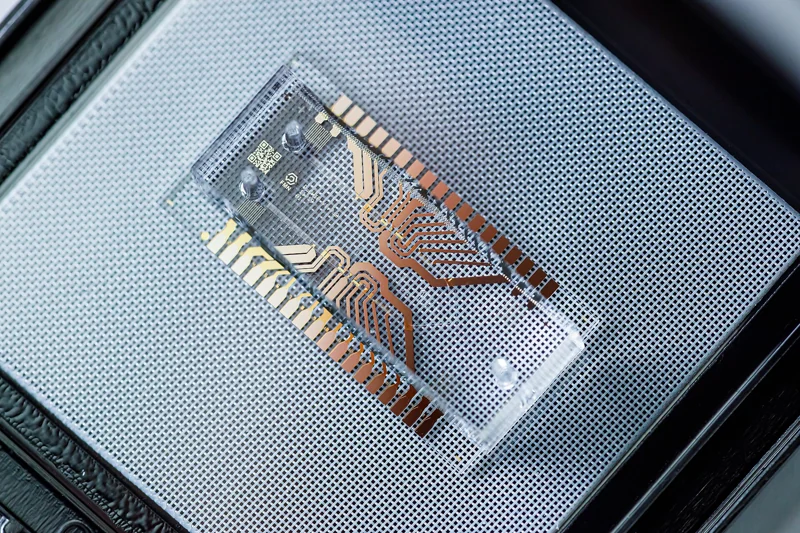
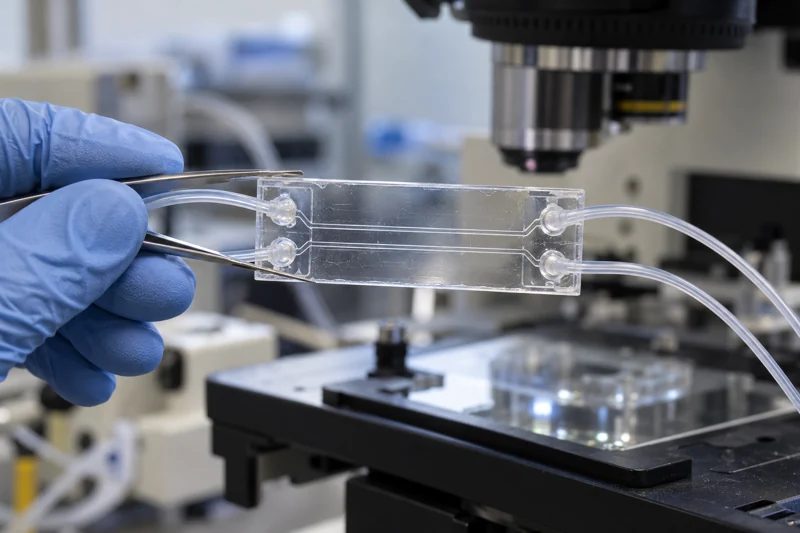
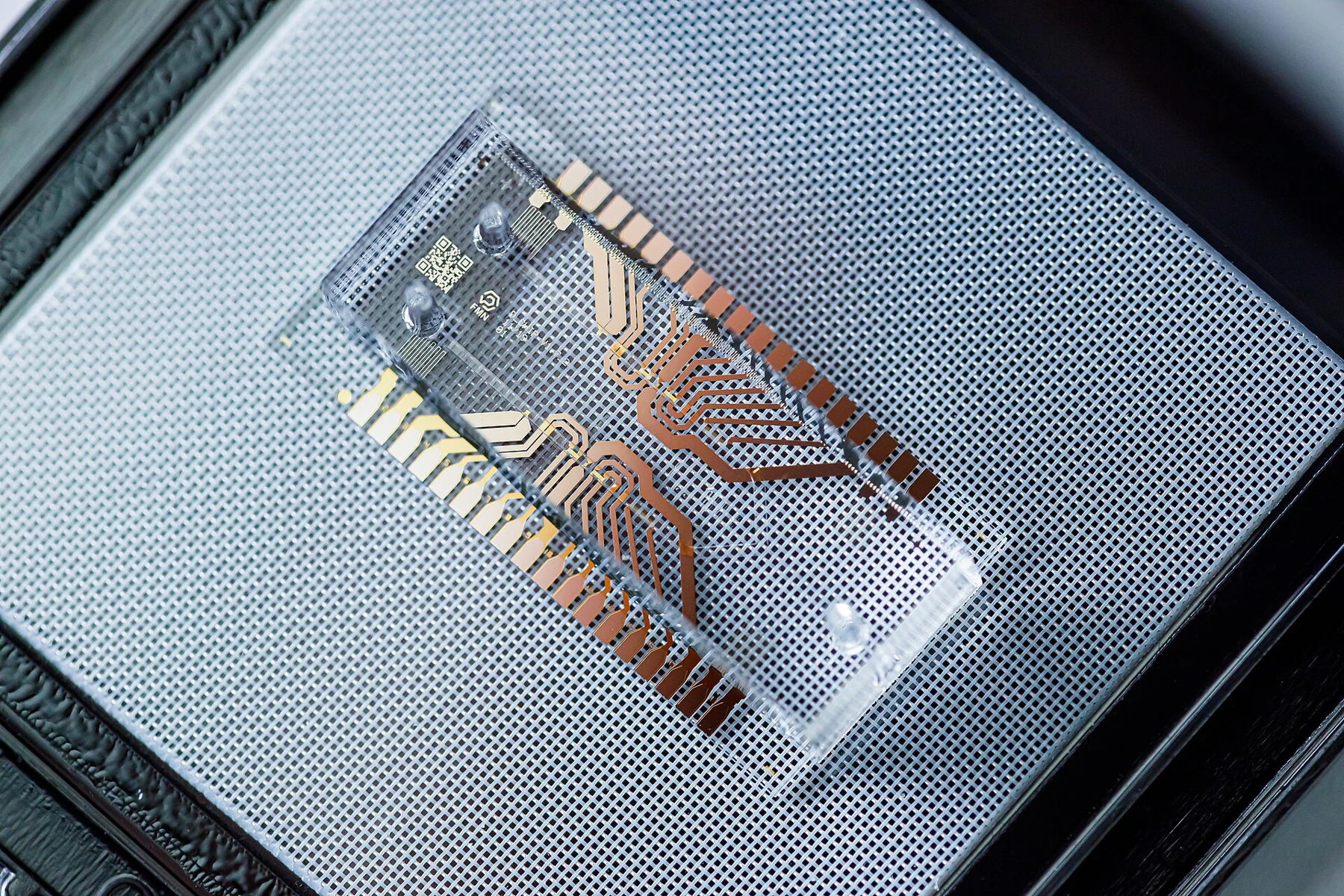
The team examined motion in a glass flow device and a Ψ-shaped microfluidic channel. Such geometries can establish controlled neighboring streams and let researchers observe particles under a defined chemical environment. They are useful for testing directionality because the investigator can compare movement relative to a known source instead of relying on an uncontrolled bulk mixture.
The paper combines experiments with dissipative particle dynamics simulations. In the simulations, LA preferentially entered the modeled membrane and disrupted the organized PEG-rich outer region, exposing PLA. The authors also tested related weak-acid cues and alanine as a non-interacting zwitterionic control; they report that the weak acids inducing PLA rearrangement also induced negative motion, while alanine did not. These comparisons support a link between solute–polymer interaction and behavior, though the range of tested molecules remains limited. [1]
How this differs from an enzyme-powered liposome
An earlier study demonstrated both positive and negative chemotaxis in enzyme-coated liposomes. It attributed direction to interactions involving catalytic substrates or products and, in some conditions, salts interacting with phospholipid membranes. Those particles carried enzymes and used lipid-based shells; the 2026 polymersomes use a different polymer membrane and report a conformationally driven route. The comparison shows that “synthetic chemotaxis” names an outcome, not one universal mechanism. [2]
The newer work therefore adds a distinct design example: the same material interface can participate in cue recognition and generate the mechanical asymmetry associated with motion. It does not establish that this mechanism is more efficient, more robust or more suitable for applications than enzyme-powered alternatives. Those questions require matched experiments.
A worked example separates a gradient response from a device
Imagine a microfluidic channel carrying a steady LA gradient from left to right, with fluorescently tracked polymersomes starting at several positions. If their average displacement is toward the left and controls without an interacting cue do not show the same shift, that pattern supports movement away from LA under those conditions. Reversing the gradient and reproducing the reversal would strengthen the directional interpretation. These are examples of useful checks, not additional experiments claimed by the paper.
Even a reproducible laboratory response would not yet make the vesicles a delivery system. A practical carrier would need to retain cargo, move in biologically relevant fluids, avoid unwanted interactions, respond to a cue present at the right place and time, and do so safely. The study does not report a therapeutic payload or animal performance. The distinction between a mechanism demonstration and an application is the same one that applies to other microfluidic research advances.
What remains uncertain
The reported evidence combines channel observations, chemical controls and simulations, but several boundaries remain. The experiments concern a selected polymer composition and cue set; they do not show that arbitrary polymersomes will respond similarly. The proposed mechanism depends on LA–PLA interactions and membrane mobility, so changing polymer architecture, vesicle size, solution conditions or gradient strength could change or eliminate the response. Independent replication and systematic parameter sweeps would help map those limits. [1]
There is also a terminology question. In living cells, chemotaxis can involve active sensing and regulated motility, while small particles can drift through physical interactions with gradients. The 2026 paper reports using a flowchart-guided analytical framework and controls to assess competing explanations, including osmophoresis; it reports no detectable shift in the glucose control. Such checks help distinguish the proposed LA response from alternatives under the tested conditions, while further work can establish how broadly the interpretation holds. [1]
A small system makes a useful design principle visible
The study’s practical contribution is a proposed route from molecular interaction to particle-scale direction: cue binding changes polymer conformation, conformation changes the interface, and interfacial asymmetry drives motion. That chain gives materials researchers specific variables to test rather than treating movement as a black-box feature. Polymer chemistry, membrane dynamics and fluid geometry can be adjusted separately and compared.
For now, the result is best understood as a model of how a synthetic compartment might translate chemical information into mechanical behavior. Its significance lies in making the membrane an active part of that translation. Whether the principle can be generalized, controlled in complex environments or used for a useful task remains open; those next steps will determine how far this laboratory finding can travel.
A lactic-acid gradient was reported to make PEG-b-PLA polymersomes migrate away from its source. The proposed mechanism is membrane conformational change coupled to interfacial stress, supported by experiments and simulations; broader generality and applications remain to be tested.
Sources & further reading
Numbered references connect claims to their source. The main text is our original explanation; conceptual examples are identified as imagined.
- Wang et al. — Conformationally driven negative chemotaxis in synthetic vesiclesResearch paper · Nature Chemistry · 11 November 2026
- Somasundar et al. — Positive and negative chemotaxis of enzyme-coated liposome motorsResearch paper · Nature Nanotechnology · 18 November 2019
Source review: 12 Nov 2026. Editorial standards.