What a pH measurement describes
pH expresses hydrogen-ion activity on a logarithmic scale. In common notation, pH = −log₁₀ a(H⁺), where activity represents an effective chemical amount relative to a reference state. It is dimensionless. In sufficiently dilute solutions, concentration can sometimes serve as a useful approximation, but activity and concentration are not interchangeable under every condition.
The scale is useful because hydrogen-ion conditions influence chemical equilibria, surface interactions and biological processes. A measured pH is therefore a compact description of one important aspect of a solution. It is not a complete chemical analysis. USGS explains its relevance to water quality while emphasizing that a pH value belongs to the particular water being measured. [1]
Why one unit is a tenfold change
The logarithm compresses a very wide range into manageable numbers. In an educational comparison, water at pH 5 has ten times the hydrogen-ion activity of water at pH 6. Relative to pH 7, the difference is a factor of 100. A decrease of 0.5 units corresponds to a factor of about 3.16, rather than half of a fixed linear step.
The relationship can be written as an activity ratio: a₁/a₂ = 10^(pH₂ − pH₁). Notice the order of the subtraction. The lower-pH sample has the higher hydrogen-ion activity. This calculation is useful for comparing conditions, but it does not tell us how much acid was added or how strongly a sample will resist a future addition. Those are different questions.
Neutral does not always mean exactly seven
Neutrality means that hydrogen and hydroxide activities are equal under the conditions in question. At approximately 25°C in an idealized dilute-water treatment, the familiar neutral value is near pH 7. Temperature changes the relevant water equilibrium, so the neutral pH is temperature dependent.
A comparison between measurements should therefore include temperature and the nature of the sample. A warm solution and a cooler one need not have the same neutral reference point. This does not make the pH scale unreliable; it means that its interpretation depends on chemistry. The same caution applies to very concentrated or unusual solutions, where simplified dilute-water assumptions may no longer be appropriate. A useful explanation states the conditions under which its numerical shortcut works.
pH and buffering describe different properties
Imagine two water samples with the same initial pH. A small addition of acid causes a large change in one and a much smaller change in the other. The initial pH values were identical, but the samples contained different chemical systems able to respond to the added acid. A buffer can consume some added acid or base through an equilibrium involving related chemical forms.
For natural waters, alkalinity is a useful measure of acid-neutralizing capacity. Bicarbonate, carbonate and other species can contribute. USGS describes alkalinity measurement by controlled acid addition while monitoring the response. [2] This property should not be confused with the initial pH or with the everyday adjective “alkaline.” A single reading cannot reveal the full amount of acid a water body can neutralize.
Why averaging two pH values can be misleading
Suppose an idealized example mixes equal volumes of an unbuffered strong-acid solution at pH 3 and pure water, neglecting water's own contribution and activity corrections. Dilution halves the hydrogen-ion concentration, so the resulting pH is approximately 3.30. It is not the arithmetic average of 3 and 7, which would be 5.
Real mixtures can be more complicated because acids and bases react, buffers redistribute and ionic interactions change. The example is not a recipe for predicting arbitrary water mixtures. It demonstrates why the logarithmic labels must be connected back to chemical amounts and equilibria before mixing is analysed. Adding the displayed pH numbers as though they were concentrations loses the relationship that the scale was designed to represent.
Acid strength differs from the amount of acid present
A strong acid dissociates much more extensively in water than a weak acid under suitable dilute-solution conditions. Concentration describes how much acid is present; strength concerns the equilibrium associated with donating a proton. The words do not mean the same thing. A dilute solution of a strong acid is not automatically more acidic than every concentrated solution of a weak acid.
For a weak acid, the balance between protonated and deprotonated forms links pH to composition and equilibrium. That relationship also underlies buffering. Keeping strength, concentration and pH distinct prevents several common mistakes, including assuming that a measured pH reveals the total amount of acid in a mixture or predicts its full response to dilution.
Measurement requires a suitable comparison
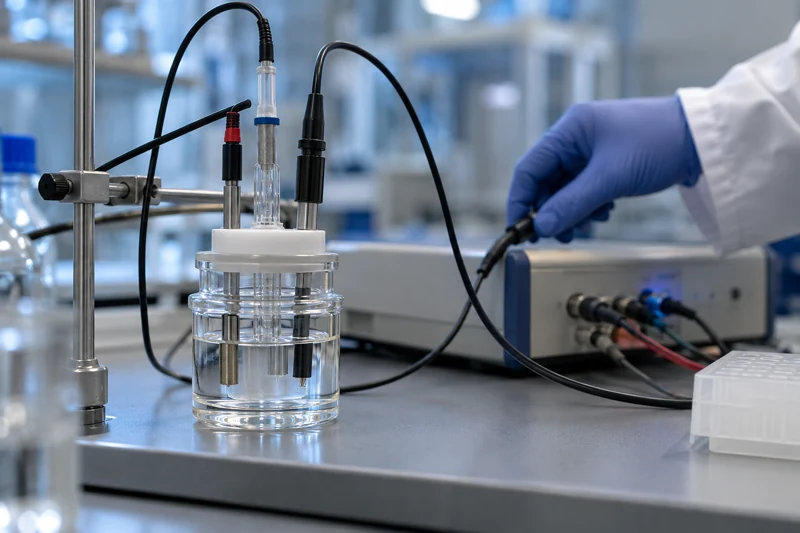
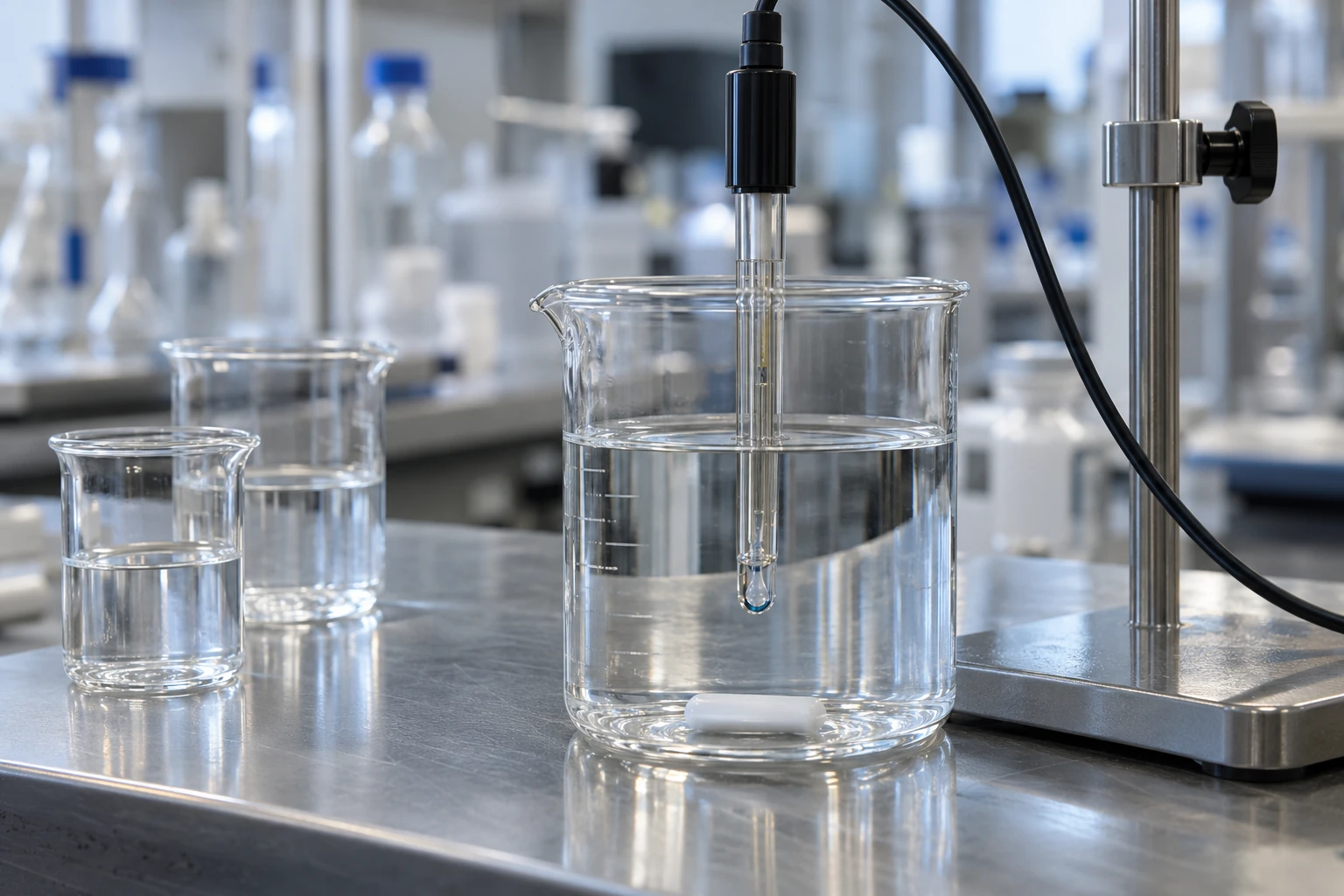
A pH electrode produces an electrical response related to the sample and its reference system. Calibration against suitable buffer standards helps connect that response to a pH value. A measurement can be affected by temperature, the electrode's condition, contamination and whether the sample has reached a stable reading.
Reporting many decimal places is not the same as establishing a correspondingly small uncertainty. A useful comparison uses an appropriate calibration range and describes conditions that could change the result. NIST's guidance on measurement uncertainty provides the broader principle: the reported value should be understood together with the factors that limit confidence in it. [3] For an everyday reader, the key question is whether an apparent change is larger than the measurement's plausible variation.
Why water systems care about pH
Acid–base conditions can influence which chemical forms are present in water and how substances interact with surfaces. That helps explain why pH appears in discussions of treatment, corrosion, aquatic environments and laboratory assays. The same numerical reading can have different implications in different mixtures because the other dissolved substances and materials are different.
Consider an invented treatment comparison in which two waters have the same pH but different buffering capacity. Adjusting both to a target value may require different amounts of reagent. Their responses to contact with a pipe or treatment medium can also differ. The practical lesson is that pH is a useful operating variable, not a stand-alone certificate that water is safe, free of contaminants or appropriate for every process.
Using the scale to ask better questions
The site's pH comparison tool illustrates how a difference on the scale becomes a ratio of hydrogen-ion activities. It does not determine a water sample's complete composition, prescribe chemical dosing or calculate the equilibrium after arbitrary substances are mixed. Its purpose is to make the logarithmic relationship tangible.
When a claim describes water as having a “better” pH, ask what job that value is meant to support. Was the sample measured under relevant conditions? What buffering capacity and dissolved substances accompany the reading? Does the claim concern a chemical process, an ecosystem or a personal health benefit that would require separate evidence? Understanding what pH measures makes it more useful precisely because it prevents one compact number from carrying conclusions it cannot establish.
Understanding a logarithmic scale makes water measurements and chemistry claims easier to interpret.
Sources & further reading
Numbered references connect claims to their source. The main text is our original explanation; conceptual examples are identified as imagined.
- USGS Water Science School — pH and WaterGovernment · foundational reference
- USGS Water Science School — Alkalinity and WaterGovernment · acid neutralization and buffering
- NIST — Guidelines for evaluating and expressing measurement uncertaintyGovernment metrology reference · Technical Note 1297
Source review: 30 Oct 2026. Editorial standards.