The cleanup problem begins with molecular structure
PFAS are a large family of substances rather than a single pollutant. Their structures and uses vary, but many environmentally persistent examples contain extensively fluorinated carbon groups. The properties that make these groups useful in demanding products can also make the resulting waste difficult to transform. A cleanup process therefore faces two distinct tasks: finding the compounds in a complicated mixture and changing them into products that can be managed more safely.
Those tasks are easy to confuse in a headline. Water leaving a treatment unit may contain much less of a measured PFAS while the collected molecules remain on an adsorbent or in a concentrated liquid. The immediate separation can be useful without resolving the long-term fate of the waste. The difference becomes central when assessing new destruction chemistry.
What the 2026 study actually demonstrated
In a paper published online on 20 January 2026, Bidushi Sarkar and colleagues investigated an electrochemical route involving lithium metal deposited at an electrode. Their experiment with perfluorooctanoic acid, or PFOA, reported 95% degradation and 94% defluorination, with lithium fluoride among the products. The authors reported no shorter C2–C6 PFAS as end products in that test. These numbers describe the study's conditions and measurements; they are not treatment guarantees for every member of the PFAS family. [1]
The distinction between degradation and defluorination matters. Degradation tracks loss of the starting compound. Defluorination tracks removal of fluorine from organic molecules. A process can perform well on the first measure while leaving fluorinated fragments, which is why measuring both is more informative than reporting disappearance alone.
Why supplying electrons can change the chemistry
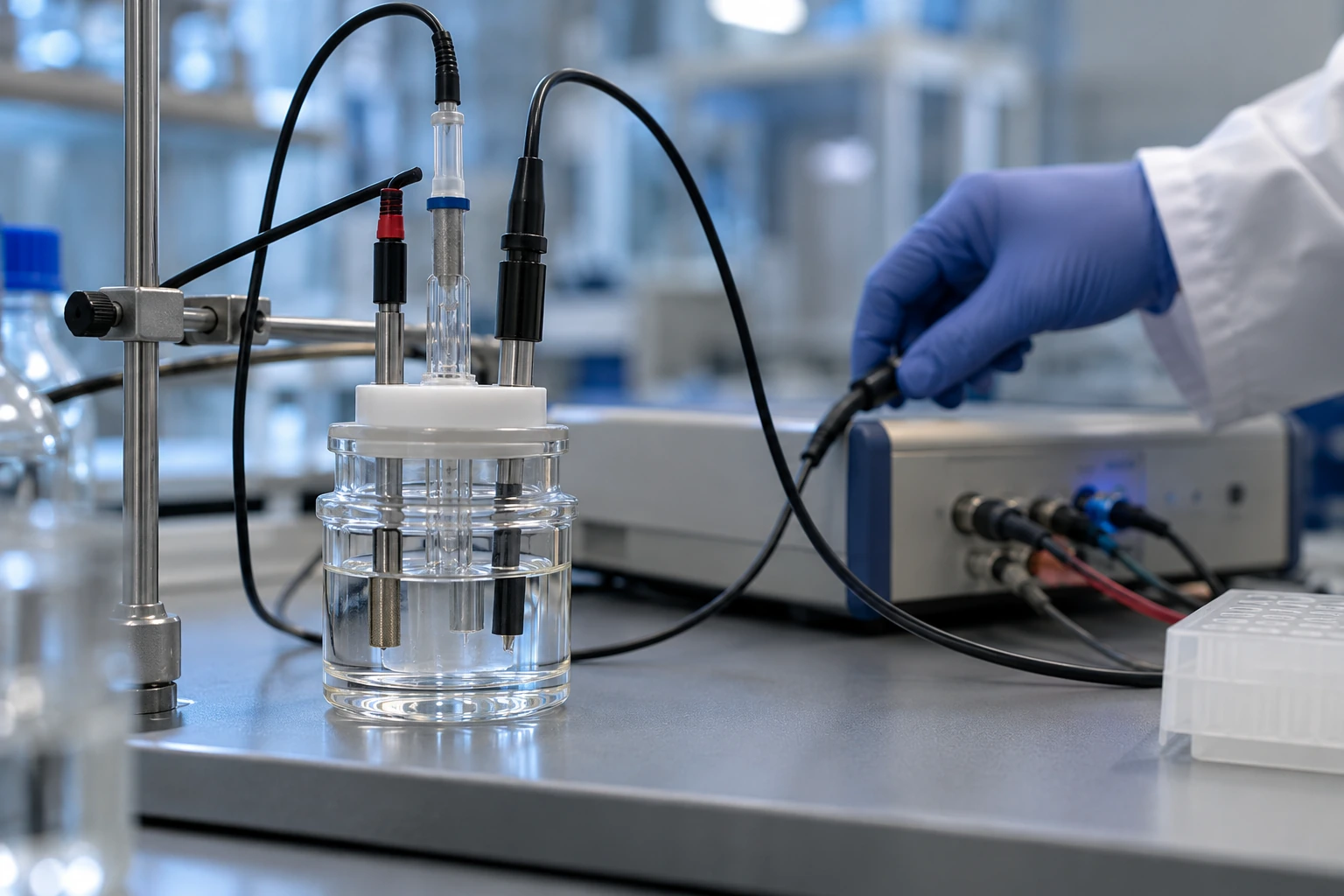
An electrochemical cell couples chemical change to the movement of electric charge. At a cathode, a species can receive electrons: chemists call that reduction. The important question is not simply whether electricity is available, but which reaction uses the electrons under the conditions inside the cell. Solvent, electrode surface and competing substances all influence that choice.
In the reported system, deposited lithium provides a route for highly reducing chemistry. Formation of an inorganic fluoride product helps explain why this is a chemical transformation rather than a filtering step. It also introduces practical questions about reagent consumption and product handling. This is specialized laboratory and process research, not a method to reproduce in a kitchen or attach directly to a domestic water pipe. [1]
Following fluorine rather than just a chemical name
Consider an invented accounting example. A reactor receives material containing 100 units of fluorine initially bound in a target organic compound. An analysis after treatment finds 90 units as inorganic fluoride, five still in measured organic compounds and five not yet accounted for. The disappearance of the original molecule cannot tell us where that last fraction went.
A useful material balance therefore combines measurements of the starting substances, transformation products and relevant output streams. Missing fluorine could reflect unmeasured compounds, sampling losses or material retained in equipment; the balance identifies a question, not an automatic explanation. Real experiments need validated methods and uncertainty estimates. The example illustrates why a high removal percentage and a convincing account of destruction are different kinds of evidence.
How capture and destruction could work together
Treating a very dilute pollutant in a huge volume of water can be different from treating a smaller concentrated waste stream. An imagined treatment chain starts with adsorption or another separation, producing cleaner water and a PFAS-rich residual. A subsequent process addresses that residual. The advantage would be focusing the demanding chemistry on less material; the disadvantage is that concentrating pollutants also concentrates other substances that may interfere.
Activated carbon, ion exchange and membranes provide different separation mechanisms. None should be assumed to destroy every captured molecule. Selection depends on the water composition and the compounds of concern. The treatment train must include the handling of spent media, regenerant or membrane concentrate, rather than ending the analysis at the clean-water outlet. [2]
Real waste is more complicated than a model solution
A controlled solution allows researchers to isolate a mechanism. Industrial residues can contain salts, organic matter, several PFAS classes and solids. These components may compete for a reactive surface or change the transport of substances to an electrode. A process that works with one deliberately selected compound therefore needs further testing before its result can be generalized.
Water content and solvent management are especially important questions for a lithium-mediated system. Engineering would have to establish how feed preparation, reaction, separation and recovery fit together. The useful performance measures include energy per amount of contaminant transformed, consumption of chemicals, equipment lifetime and the composition of every significant residual. A rapid reaction alone does not determine whether the complete process is economical or environmentally preferable.
A reaction also needs material to reach the electrode
Electrochemical performance depends on transport as well as chemical reactivity. A molecule in the bulk liquid must reach the region where it can participate in the relevant reaction. Electrode area, liquid movement and the concentration near a surface can therefore influence the measured rate. Making a reactor larger is not simply a matter of multiplying the liquid volume.
This creates an important scale-up question: can the system provide the required contact while maintaining suitable operating conditions? If transport becomes limiting, a more reactive chemical pathway may not translate directly into a faster complete process. Engineering tests need to establish which limitation dominates and how the answer changes with the composition and amount of material being treated.
What a meaningful comparison would measure
Imagine two proposed processes that both report 95% reduction in the concentration of PFOA. One uses much more water for washing; the other produces a smaller but more difficult residual. Comparing the percentages alone misses the practical differences. A fair comparison uses the same input, analytical boundaries and required final outcome.
It also separates destruction from containment. EPA's 2026 interim guidance discusses established waste-management approaches, emerging technologies and important uncertainties. The document is non-binding guidance, and it does not constitute approval of every new method described in the research literature. Its broader relevance is that release pathways, waste characteristics and the quality of performance data belong in the evaluation alongside the main reaction result. [3]
Why this matters to communities and industry
Communities need reliable drinking-water protection, while treatment operators must manage what their equipment collects. A successful destruction process could eventually reduce the burden associated with concentrated PFAS wastes. Whether it delivers that benefit depends on infrastructure, operating expertise, cost and independently verified results under realistic conditions.
The scientific advance is valuable because it expands the set of chemical routes researchers can investigate. The public benefit remains a separate proposition to demonstrate. When reading the next announcement, connect the molecular result to the whole service: how much contaminated material enters, what leaves, how the residuals are managed and what resources the process consumes. Following the atoms keeps that assessment grounded even when a headline uses the word “forever.”
Watch the fate of the atoms, not just the disappearance of the starting pollutant.
Sources & further reading
Numbered references connect claims to their source. The main text is our original explanation; conceptual examples are identified as imagined.
- Sarkar et al. — Lithium metal-mediated electrochemical reduction of PFASResearch paper · Nature Chemistry · 20 January 2026
- US EPA — Overview of Drinking Water Treatment TechnologiesGovernment · treatment mechanisms
- US EPA — Interim guidance on PFAS destruction and disposalGovernment · 2026 guidance and research limitations
Source review: 30 Oct 2026. Editorial standards.