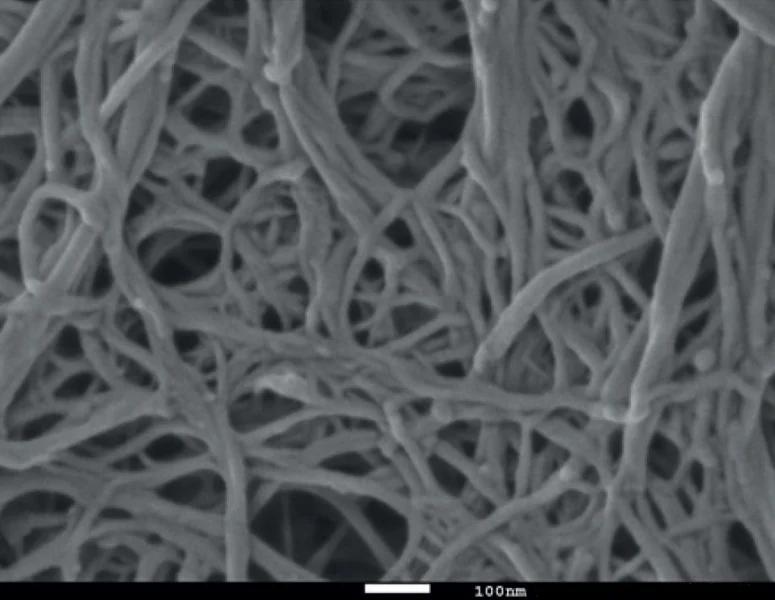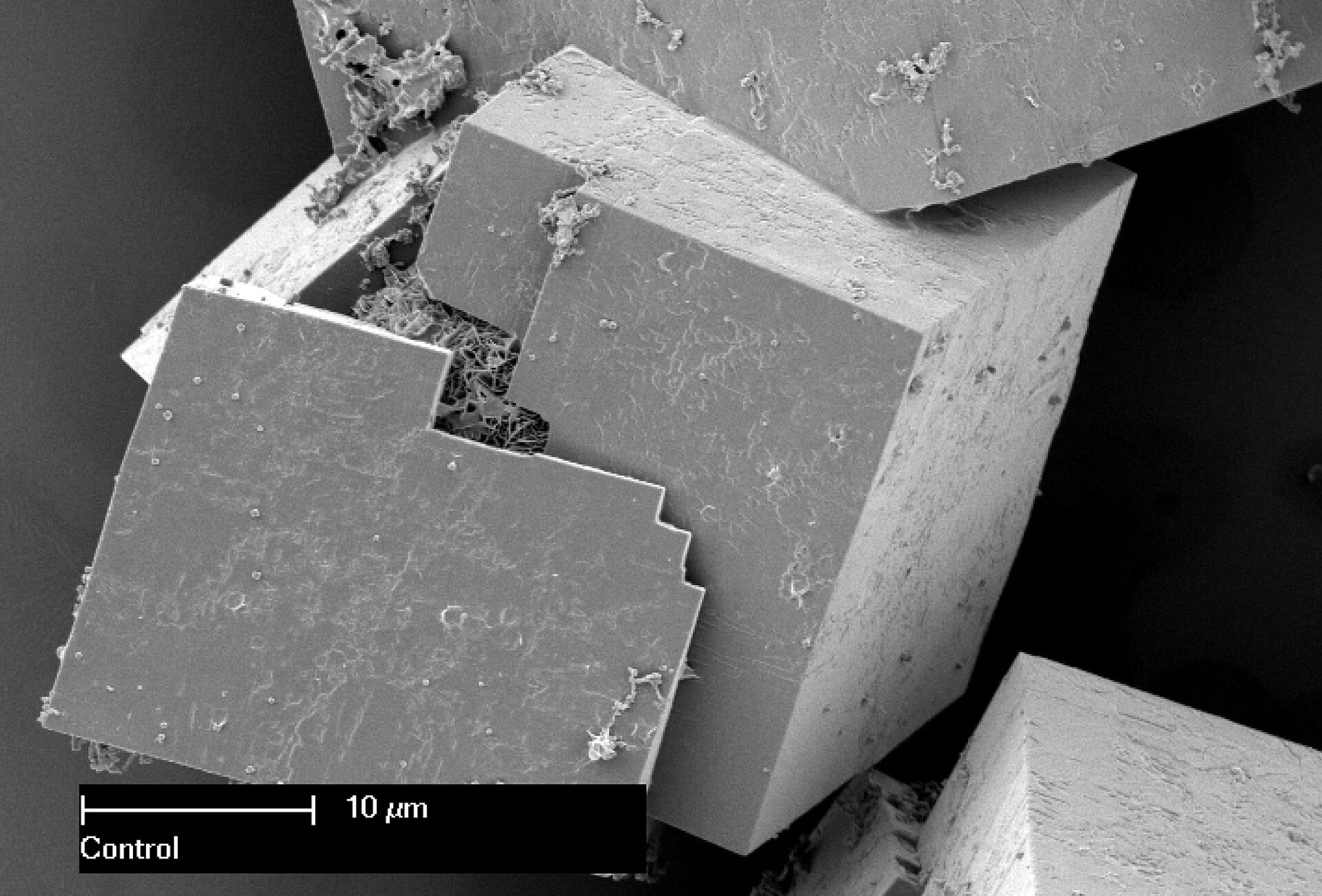
A solid can be designed around its empty spaces
A block of material may look dense while containing a network of spaces too small to see with an ordinary microscope. Those spaces determine which molecules can enter, how quickly they move and what interactions they experience. In a useful porous solid, the framework is not merely supporting an empty volume: it defines a chemical environment.
Metal–organic frameworks, usually shortened to MOFs, combine metal-containing connection points with organic linkers. The repeating network can contain potential voids whose size and surface chemistry depend on the components and their arrangement. Chemists can therefore treat the internal space as a design variable. The idea connects molecular structure with practical tasks such as separating gases or collecting water vapour. [1]
What the 2025 Nobel recognized
The 2025 Nobel Prize in Chemistry went to Susumu Kitagawa, Richard Robson and Omar M. Yaghi for developing metal–organic frameworks. The recognition concerned a field of molecular architecture and the experimental work that established its possibilities. It was not an endorsement of every proposed MOF-based product or a claim that one framework solves all separation problems. [2]
That distinction matters because a scientific platform can be powerful before any particular application becomes widely practical. A family of structures gives researchers many combinations to investigate. Each combination must still be connected to a defined task, a way to manufacture the material and a reliable operating cycle. The prize provides historical context; performance data determine whether a specific device is useful.
Nodes and linkers determine the architecture
Imagine building a repeated network using connectors that allow different numbers and directions of attachment. A connector pointing in four directions can produce a different network from one pointing in six. Changing the length or geometry of the pieces between connectors changes the spaces in the network even if its overall connectivity remains similar.
The molecular version is governed by coordination chemistry rather than rigid construction-toy rules. Metal ions or clusters interact with binding groups on organic molecules, and the conditions of assembly influence the resulting structure. A longer linker does not automatically yield a robust larger pore: the network may form differently or lose stability. Structural characterization is needed to establish what was actually synthesized, rather than assuming that the intended architecture formed.
Adsorption happens at an internal surface
When a molecule accumulates at a surface, chemists call the process adsorption. This differs from simply dissolving throughout a liquid or another bulk phase. A porous material can present a large internal surface within a small external object, but access to that surface depends on openings, connectivity and the ability of molecules to move through the network.
Capture is also selective to varying degrees. A molecule's size, charge distribution and interactions with exposed chemical groups can favour its uptake relative to a competitor. Two gases that fit through the same opening need not be held equally strongly. Conversely, a very attractive binding site is of little help if the target cannot reach it quickly enough during the time available in a working process.
How a framework becomes an established structure
A proposed molecular design is not evidence that a particular framework formed. Diffraction measurements can test the repeating structure of a crystalline product, while composition measurements help establish which components it contains. Adsorption experiments then address whether the expected internal space is accessible under the conditions tested.
These observations answer different questions. A recognizable diffraction pattern does not by itself establish useful gas capacity, and uptake alone does not determine every structural detail. Changes after repeated use may require both kinds of measurement to interpret. The most convincing account connects synthesis, structure and function, with enough characterization to show that the material doing the work is the material the structural explanation describes.
Why an adsorption curve is not a device specification
A material may be tested by measuring how much gas it takes up at different pressures while temperature is held constant. The resulting adsorption isotherm describes that material under those conditions. It can reveal useful capacity and pressure dependence, but it does not by itself tell us how a packed bed will perform with a flowing mixture.
An operating device adds transport through particles, contact between gas and solid, heat released during uptake and pressure losses through the bed. Binding water or another competing molecule may change the behaviour observed with a dry pure gas. The scientific background to the Nobel prize describes how framework design opened these areas of investigation. Translating the structural idea into a reliable process requires additional engineering evidence. [1]
A worked example: capacity available between two states
Consider a deliberately simplified, invented material. At the chosen capture conditions, it holds four units of a target substance per unit mass of solid. At the chosen release conditions, it still holds three. Only one unit is available between those two operating states. Another material that holds three units during capture and one during release offers a larger working capacity, even though its maximum uptake is lower.
The numbers are illustrative, not measurements of a real MOF. They explain why a headline about record uptake can miss the most useful comparison. Temperature and pressure changes used for release also cost energy. A practical design balances the amount moved in each cycle, the resources needed to regenerate the solid and the speed with which the cycle can be repeated.
Water harvesting exposes the complete challenge
Collecting water from air requires several steps. Water vapour must enter the material, then be released under changed conditions, and finally be collected as liquid or otherwise delivered in a usable form. A promising adsorption result addresses only part of that sequence. The complete system must also move air, transfer heat and avoid introducing contaminants.
This application is among those discussed in the Nobel background. [2] Its appeal is easy to understand in places where water supply is difficult, but local humidity and temperature affect the available resource. The relevant comparison is water delivered per day at an acceptable quality, along with the energy, equipment and replacement material required. A crystal's behaviour and a community's water supply are connected through this wider system.
Why the material's lifetime matters
A framework may encounter moisture, repeated heating, compression or chemically reactive impurities. Its structure and performance must remain suitable through those conditions. A device can lose usefulness even if the framework remains partly crystalline: blocked pores, slower transport or contaminants in the product may matter before complete structural collapse occurs.
Manufacturing adds another set of choices. Shaping powder into usable particles can affect accessible pore space and flow resistance, while synthesis and purification require resources of their own. The strongest applications will match a particular framework to an operating environment where its advantages survive these demands. MOFs make molecular environments unusually designable. Their impact depends on turning that design into a material that continues to do a useful job outside the discovery experiment.
The best porous material is the one whose capture, release and lifetime fit the actual job.
Sources & further reading
Numbered references connect claims to their source. The main text is our original explanation; conceptual examples are identified as imagined.
- Royal Swedish Academy of Sciences — Scientific background to the 2025 chemistry prizeScientific academy · framework chemistry background
- Nobel Prize in Chemistry 2025 — Popular science backgroundRoyal Swedish Academy of Sciences · 2025
Source review: 30 Oct 2026. Editorial standards.